SEO reporting can get messy very quickly.
Rankings in one place. Traffic in another. Google Search Console doing its thing. Google Business Profile tucked away somewhere else. Then AI search arrives and adds another layer to the pile.
Lovely.
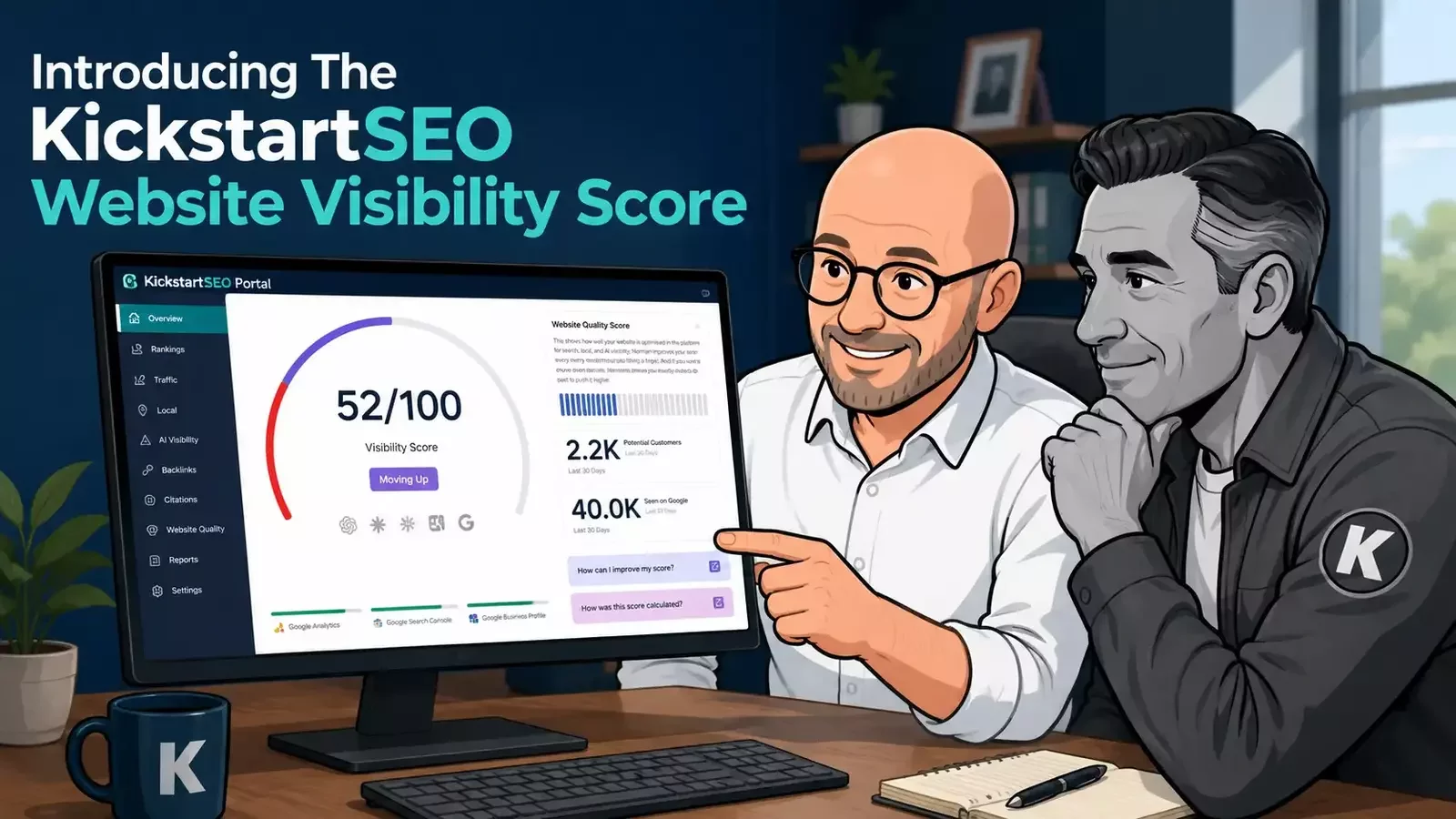
That is why we built the KickstartSEO Website Visibility Score, implemented on 22 June 2026.
It gives clients one clear score inside the KickstartSEO Portal, so they can see how their overall visibility is moving without having to piece together eight different signals like a digital jigsaw puzzle with missing corners.
What's inside? (TL;DR)
This article explains why we built the KickstartSEO Website Visibility Score and how it brings several important SEO signals into one clearer view.
It also explains why the score is not designed as a vanity metric, but as a practical way to measure progress and spot what needs attention.
Useful Sections
Estimated reading time:
7 minutes
What Is The Website Visibility Score?
The Website Visibility Score is a single measurement inside the KickstartSEO Portal.
It brings together the main signals that affect how visible a business is across search, local results, AI discovery, and overall website performance.
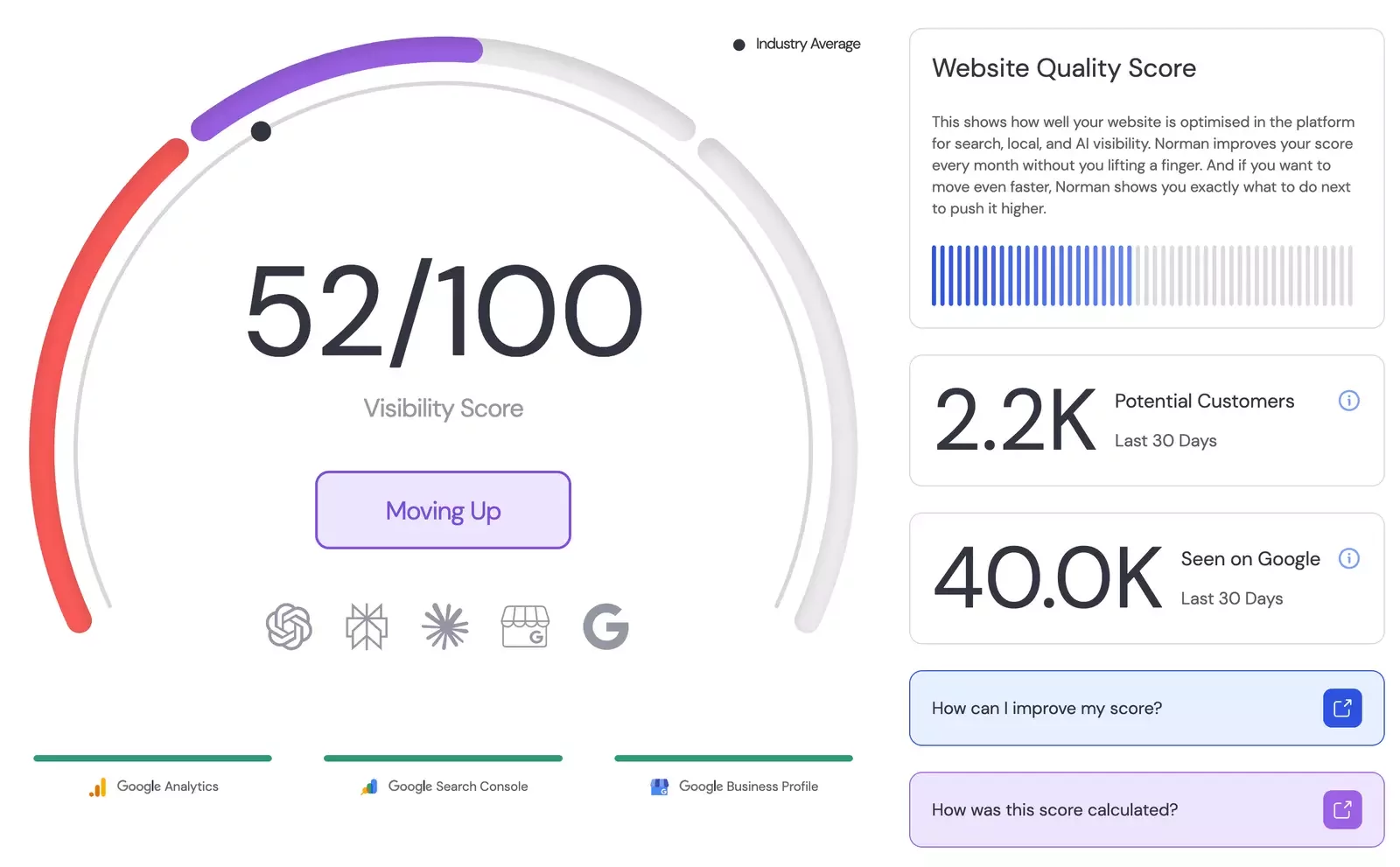
It does not replace the detailed reports. Those still matter.
But most business owners do not want to spend their week decoding charts, tabs, reports, and graphs that look useful until you actually need a decision from them.
They want to know:
Is this working?
Are we moving in the right direction?
What needs attention next?
That is what the score is designed to make clearer.
The Eight Signals Behind The Score
The Website Visibility Score looks at eight real signals.
Each signal tells part of the story. Together, they give a clearer view of how visible your business is online.
Rankings
Rankings show where your website appears for the search terms being tracked.
They still matter because Google search remains one of the main ways potential customers find businesses. Rankings are not the whole story, but they show whether your pages are gaining ground, holding steady, or slipping.
Moving from page five to page two may not flood your inbox overnight, but it tells us something useful.
Progress is happening.
Traffic
Traffic shows how many people are visiting your website.
This helps us see whether better visibility is turning into actual visits. A website can rank for some phrases and still fail to attract useful traffic if the wrong keywords are being targeted, the search demand is weak, or the page does not earn the click.
Traffic gives us the next layer of evidence.
Search Impressions
Search impressions show how often your website appears in search results.
This matters because impressions can rise before clicks do. Google may start showing your website across more searches before those extra appearances turn into visits.
In plain English, your website may be getting seen more often before people start clicking more often.
That is not the finish line, but it can be an early sign that things are moving.
Google Maps Visibility
For local businesses, Google Maps visibility matters a lot.
This signal looks at how visible your business is in local and map-based searches, including activity connected to your Google Business Profile.
If someone nearby is looking for what you do, your business needs to be in the running.
Being good at what you do helps. Being findable when people need you helps more.
AI Visibility
AI visibility looks at how your business is being discovered, understood, or referenced in AI-led search environments.
People are no longer only using traditional Google results. They are asking tools such as ChatGPT, Perplexity, Claude and Gemini to explain options, compare businesses, and answer buying questions.
Google is also building AI features in Google Search, so this is not just about separate AI tools sitting off to one side.
That does not mean we ignore traditional Google search. That would be daft.
It means we also pay attention to whether your business can be found and understood when people search in newer ways.
Backlinks
Backlinks are links from other websites to yours.
Good backlinks can support authority, relevance, and trust. A weak or poor-quality link profile can limit how strongly your website is understood by search engines.
Backlinks are not about collecting random links like stamps.
They are about having the right signals in the right places.
Citations
Citations are mentions of your business details across trusted directories, platforms, and local sources.
For local SEO, consistency matters. Your business name, address, phone number, website, and other key details should be accurate across the web.
If your business information is inconsistent, search engines may be less confident about it.
And when search engines are unsure, they rarely say, “Let’s give this one the benefit of the doubt.”
They just move on.
Website Quality
Website quality looks at how well your website is built, structured, optimised, and maintained.
A website can look fine on the surface and still have issues underneath. Weak page structure, thin content, missing optimisation, technical problems, or poor user experience can all hold visibility back.
Website quality is the foundation.
If the foundations are wobbly, everything else has to work harder than it should.
Why We Built One Score
The score exists because reporting should help people make decisions.
That sounds obvious, but plenty of SEO reporting manages to do the opposite. It produces numbers, charts, and exports without making the next step any clearer.
We wanted a better way to pull the main signals together.
The Website Visibility Score gives clients the bigger picture first. Then, inside the portal, they can dig into the individual areas behind the score.
That makes the conversation more useful. Not just, “Your clicks are up.”
More like, “Your impressions are improving, your local visibility is moving, but website quality is still holding things back. That is where we should focus next.”
Much better. Fewer spreadsheet headaches. Everyone wins.
How The Industry Average Works
The score also includes an industry average.
This is based on Google-provided measurements for your specific market, so the comparison is fairer and more useful.
That matters because not every industry behaves the same way in search. A florist, an accountant, a roofer, and a business consultant will not have the same search demand, competition, traffic patterns, or local visibility.
They should not all be judged against the same generic benchmark.
The industry average helps keep the playing field level.
It gives your score proper context instead of comparing your business against a vague number dressed up as insight.
We have all seen enough of those, thank you.
This Is Not A Vanity Metric
We did not build this score to make ourselves look clever.
That would be easy. Set the bar low, hand everyone a lovely score, admire the dashboard, and pretend everything is marvellous.
No thanks.
We have set a high bar because the score needs to be useful. It should help us measure real performance, not create a “look how good we are” moment.
If the score highlights a weak area, good. That gives us something to fix.
If the score improves, better. That gives us evidence that the right work is making a difference.
The point is not prettier reporting. The point is clearer progress.
What Clients See In The Portal
The Website Visibility Score sits at the top of the KickstartSEO Portal.
From there, clients can see the headline score and then move into the supporting areas, including traffic, search performance, AI traffic, keyword movement, local visibility and website quality.
The score gives the summary. The portal gives the detail.
Together, they help answer the question every business owner eventually asks about SEO: What is actually happening?
That is the question reporting should answer without making people feel like they need a cup of tea, a lie down, and a minor qualification in analytics.
Why This Matters For Small Businesses
Small businesses do not need more confusion.
They need clear reporting that helps them understand whether their website is becoming more visible, where progress is happening, and what needs attention next.
SEO is rarely one dramatic event. It is usually steady work across multiple signals.
Some things move quickly. Some take longer. Some improve quietly in the background before the visible results catch up.
The Website Visibility Score helps bring those moving parts into one view. It does not pretend SEO is simple. It makes it easier to understand.
The Goal Is Better Decisions
The Website Visibility Score gives us a clearer way to measure visibility across Google, local search, AI discovery, backlinks, citations, traffic, rankings, and website quality.
That means clearer reporting, better conversations, and sharper priorities.
That is why we built it. Not because the world needed another dashboard. Because small businesses need to know what is working, what is not, and what happens next.
Can We Help?
Many people end up on our blog because their SEO is not working the way they hoped, and they are trying to work out what to do next.
Sound familiar?
If your SEO reporting gives you plenty of numbers but no clear direction, that is the problem this score was built to solve.
Visibility only becomes useful when you can see what is improving, what is holding things back, and where the next sensible bit of work should go.