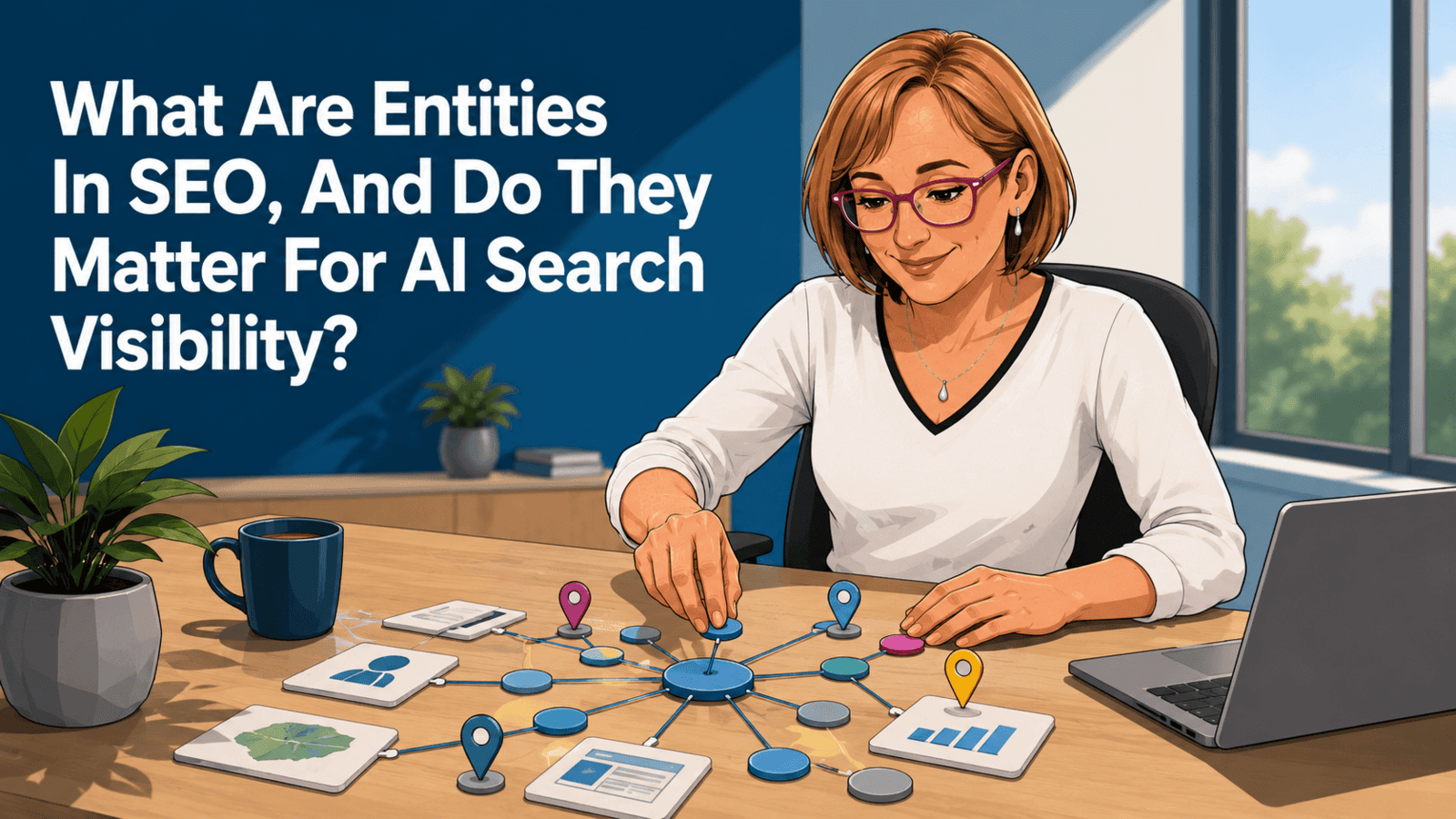
If you spend long enough around SEO people, someone will eventually say the word “entities” and look terribly pleased with themselves.
It sounds clever. It sounds technical. It sounds like the sort of thing that might require a diagram, three acronyms, and a cup of tea before anyone admits they are guessing.
But entities are not as mysterious as they sound.
What's inside? (TL;DR)
Entities sound technical, but they are really about helping search engines and AI systems understand people, businesses, services, places, topics, and how they connect.
This article explains what entities mean in SEO, why they matter for AI search visibility, and what small businesses can actually do without disappearing into acronym soup.
Useful Sections
Estimated reading time:
10 minutes
In simple terms, an entity is a clearly identifiable thing.
In SEO, entities matter because search engines are no longer just matching words on a page. They are trying to understand meaning, context, relationships, and trust.
That matters even more as AI search becomes part of how people find answers.
So, yes, entities matter. But no, they are not magic. Let’s keep our feet on the ground.
First, What Is An Entity?
An entity is something distinct enough for a search engine or AI system to recognise and understand.
For example:
Each of those things has meaning beyond the words themselves.
That is the important bit.
A search engine does not only want to know that your page mentions “SEO”. It wants to understand what kind of SEO you are talking about, who provides it, who it helps, where it applies, and how that page connects to other reliable information.
Search is becoming less about isolated words and more about connected meaning.
That does not mean keywords are dead. They are not. Anyone telling you that usually has something expensive and unnecessary to sell.
Keywords still matter because people still search using words.
But keywords on their own are not enough.
Why Keywords Alone Are Not Enough
Old-school SEO often treated pages like keyword containers.
Add the phrase. Repeat the phrase. Put the phrase in the title. Put it in a heading. Sprinkle it around like parsley on a pub lunch.
Sometimes that worked. Sometimes it still helps.
But it is not a strategy by itself.
A page that says “SEO services in Northampton” fifteen times is not automatically useful. It might be clear. It might also be desperate.
Search engines need more than repetition. They need signals that help them understand:
who the business is
what the business actually does
who the service is for
where the business operates
whether the information is consistent
whether the content is useful
whether the page connects sensibly to other relevant pages
whether the business looks credible beyond its own website
That is where entities become useful.
For a small business, this is not about trying to trick Google or impress an AI platform. It is about making your business easier to understand.
That is a much better place to start.
How Entities Help Search Engines Understand Your Business
Think of your website as a collection of dots.
Search engines and AI systems are trying to connect those dots.
If the dots are clear and consistent, your business becomes easier to understand.
If the dots are vague, scattered, contradictory, or missing, your business becomes harder to interpret.
For example, a local business might have:
one version of its name on its website
a slightly different version on Google Business Profile
outdated services on an old directory listing
thin service pages that do not explain much
blog posts that do not link to related services
no clear team or author information
location pages that say almost nothing specific
That creates noise.
Search engines do not need more noise. Neither do your customers.
A good website should make the basics obvious:
who you are
what you do
who you help
where you work
why you can be trusted
what someone should do next
That is not just good SEO.
It is good communication. Makes sense, right?
What This Has To Do With AI Search Visibility
AI search has made this conversation more important.
When someone asks an AI system a question, that system has to interpret meaning. It is not just matching a phrase. It is trying to understand the question, identify useful sources, summarise information, and provide a sensible answer.
That means clarity matters.
If your website clearly explains your business, your services, your experience, your location, and your areas of expertise, you give search and AI systems a better chance of understanding where you fit.
If your website is vague, generic, or badly connected, you make that job harder.
This is where terms like GEO and AEO come in.
GEO is Generative Engine Optimisation. In plain English, that means improving your chances of being understood, referenced, or surfaced by generative AI search systems.
AEO is Answer Engine Optimisation. That means structuring content so answer-based systems can understand and use it more easily.
Both ideas have value.
Both can also be turned into nonsense with remarkable speed.
The sensible version is this:
Your website should answer real questions clearly. It should explain your business properly. It should connect related topics. It should use accurate information.
It should make your expertise obvious without turning every paragraph into a sales pitch.
That helps people.
It also helps search engines and AI systems understand you.
Funny how often those two things line up when you stop chasing shortcuts.
Entities Are About Relationships, Not Just Labels
The real value of entities is not just naming things.
It is showing how those things relate.
For example, a website might help search engines understand that:
a business provides SEO services
those services are for UK small businesses
the founder has relevant experience
the business supports specific locations
the blog content answers related SEO questions
the service pages explain what clients can actually buy
the Google Business Profile reinforces the same business details
external profiles and mentions are consistent
That creates a clearer picture.
This is why internal linking matters.
A blog about Google reviews should sensibly link to related content or services. A service page should connect to useful explanations. An about page should help clarify who is behind the business.
Internal links are not just there to move ranking power around like SEO plumbing.
They help people and search systems understand relationships.
A tidy structure beats a pile of disconnected pages.
What Small Businesses Can Actually Do
This is the bit that matters.
You do not need to become an expert in semantic SEO to benefit from entity thinking.
You do need to make your website clearer.
Here are the practical steps.
Be Clear About Who You Are
Your website should make your business identity obvious.
That means having consistent information about:
your business name
your location or service area
your team
your services
your contact details
your experience
your specialisms
Do not assume people will work it out.
If a potential customer has to dig around to understand what you do, your website is making them work too hard.
Search engines are not fond of guesswork either.
Make Your Service Pages Specific
Generic service pages do not help much.
“We help businesses grow online” could mean almost anything. It might be SEO. It might be ads. It might be branding. It might be someone with a Canva account and confidence issues.
A stronger service page explains:
what the service is
who it is for
what problem it solves
what is included
what is not included
how the process works
what the next step is
Specificity helps people make decisions.
It also helps search engines understand what the page is actually about.
Connect Related Content Properly
If you publish blogs, service pages, support pages, and location pages, they should not sit around like strangers at a bad networking event.
Connect them.
A blog answering a common question should link to the relevant service page. A service page should link to useful explanations. A location page should connect to the main service it supports.
This does not mean cramming in links for the sake of it.
It means helping the reader move naturally from one useful piece of content to the next.
If the link helps the reader, it probably helps the structure too.
Keep Your External Profiles Consistent
Your website is not the only place search engines and AI systems may encounter your business.
They may also see information from:
Google Business Profile
LinkedIn
review platforms
business directories
partner websites
social media profiles
If these profiles tell different stories, that is a problem.
A consistent name, description, location, service focus, and contact information helps reinforce the same business identity across the web.
This is not glamorous work.
Neither is checking tyre pressure.
Both matter.
Use Structured Data Where It Makes Sense
Structured data, often called schema, is code that helps search engines understand specific information on a page.
For example, structured data can help identify details about:
an organisation
a local business
a person
an article
a product
a review
an FAQ
an event
Used properly, structured data can support clearer understanding.
Google describes structured data as a way to provide clearer clues about the meaning of a page. Not as a shortcut to rankings. That distinction matters.
Used badly, structured data becomes another SEO toy people wave around while ignoring the basics.
It does not replace clear content. It supports it.
If your page is vague, thin, or unhelpful, adding schema will not suddenly make it brilliant.
That is lipstick on a confused badger.
Start with useful content. Then use structured data to reinforce what is already clear.
Publish Content That Builds Topical Clarity
One blog article rarely changes everything.
A useful body of content can.
If your business wants to be understood for a topic, your website should cover that topic properly over time.
That might include articles explaining:
pricing factors
comparisons
mistakes to avoid
process explanations
service differences
local considerations
practical examples
Again, this is not about publishing for the sake of publishing.
More content is not always better.
Better content is better.
There is a sentence that should be stitched onto a cushion and thrown at half the internet.
A Simple Example
Imagine a Northampton-based accountancy firm.
A weak version of its website might say:
“We provide professional accounting services for businesses.”
That is not wrong.
It is just not very useful.
A stronger version might say:
“We are a Northampton-based accountancy firm helping small limited companies, trades, and local service businesses with bookkeeping, tax returns, payroll, VAT, and business accounts.”
That tells people much more.
It also gives search engines more context.
The website could then support that message with:
a clear about page
specific service pages
a Google Business Profile with matching details
blog articles answering tax and bookkeeping questions
location-specific information where useful
team details that show real experience
internal links between related pages
Now the business is not just using accounting keywords.
It is building a clearer entity.
The same principle applies to SEO, plumbing, legal services, coaching, web design, pest control, or almost any small business service.
Clarity scales.
What To Ignore
Because this is SEO, there will always be someone trying to make the simple version sound inadequate.
Ignore anyone who tells you that entities are a secret switch.
Ignore entity stuffing.
Ignore schema spam.
Ignore fake author bios.
Ignore AI-generated glossary sludge.
Ignore pages written only to mention every related phrase under the sun.
Ignore tools that produce impressive-looking entity lists but no practical next step.
And be very careful with anyone promising to “optimise your brand into ChatGPT” overnight.
That might sound exciting.
So does buying a parachute from a man in a pub.
Ask better questions before handing over money.
So, Do Entities Matter?
Yes, entities matter.
They matter because search engines and AI systems are trying to understand meaning, relationships, and credibility, not just isolated keywords.
For small businesses, that means your website needs to make your business easy to understand.
You do not need to chase every new SEO phrase.
You do not need to panic every time someone posts a dramatic LinkedIn update about the future of search.
You do need clear pages, useful explanations, consistent business information, sensible internal links, and content that answers real customer questions.
That is not as glamorous as the buzzwords.
It is also much more useful.
Final Thought: Clarity Beats Cleverness
Entities sound technical because SEO people have a rare gift for making useful ideas harder to understand.
But the practical lesson is simple.
If your website makes it difficult to understand who you are, what you do, where you work, and why you can be trusted, search engines and AI systems will struggle too.
So will people.
Start there.
Make your business clearer. Connect the right pages. Explain your services properly. Keep your information consistent. Answer the questions your customers are already asking.
That is good SEO.
It is also good service.
And as search keeps changing, that is probably the safest place to stand.
If you are not sure whether your website is clear enough for Google, AI search, or actual humans with limited patience, start with the Free SEO Audit. We will show you what matters, what is noise, and what to do next.
Can We Help?
Many people end up on our blog because their SEO is not working the way they hoped, and they are trying to work out what to do next.
Sound familiar?
If this article has made you wonder whether your website is giving search engines, AI systems, and actual humans enough clarity, that is worth checking.
Most visibility problems are not solved by chasing the latest phrase; they are solved by making the right parts of your website clearer, better connected, and easier to trust.