Let’s be honest: SEO has been declared dead more times than vinyl, and yet here we are. Still talking about it. Still doing it. Still watching people panic every time Google changes the furniture.
But with AI search on the rise and Google shifting faster than ever, it is fair to ask what “SEO” will even mean in 2026.
After writing about the death of SEO in SEO Is Dead. Long Live Search Everywhere Optimisation I spent over a week working through this article. I wanted to establish a clearer way forward for KickstartSEO clients and followers.
That way forward is understanding the shift from Search Engine Optimisation to Search Everywhere Optimisation. Google is still the biggest arena, but visibility now stretches far beyond one search box.
What's inside? (TL;DR)
This article explains how SEO is moving from simple search engine rankings towards broader visibility across Google, AI search, maps, directories, and answer engines.
It looks at what still matters, what is changing, and why clear, trustworthy information will matter more than keyword stuffing.
Useful Sections
Estimated reading time:
7 minutes
We have been on this journey all year, and the pace of change has started to accelerate. Businesses need to be ready to adapt sooner than they think.
2025: Where We Are Now
If you have been developing your SEO for Google, Bing, and other traditional search engines, you are already ahead of many of your competitors.
The fundamentals still work. Clear page titles, useful headings, well-structured websites, helpful content, and a healthy SEO programme still matter.
For local businesses, Google Business Profile optimisation remains a key part of being found in Google Search and Maps.
Think of 2025 as the training phase. You are building the fitness that keeps your business visible now, while preparing for what comes next.
And what comes next is not small.
2026: The Year Of Upset
Search optimisation has always been about helping people find what they need. That has not changed.
What is changing is where people search, how answers are produced, and how much work a business needs to do before it is trusted enough to be shown.
By 2026, Google will still matter. A lot. Anyone telling you Google is finished is probably selling something, or has been sniffing the whiteboard markers again.
But Google will not be the only place people look. Search behaviour is already spreading across AI assistants, map results, social platforms, directories, review sites, marketplaces, and answer engines.
That is where the shift from Search Engine Optimisation to Search Everywhere Optimisation becomes important.
It is no longer just about how your website ranks in one search engine. It is about how clearly your business is understood across the places where people and machines go looking for answers.
Think of 2026 as the disruption phase. The basics still matter, but they are no longer the whole job.
If your business wants to be found, your website and wider online presence need to support both traditional search results and AI-assisted discovery.
From Keywords To Entities
For years, SEO was often treated as a keyword exercise.
Find the phrase. Put the phrase on the page. Repeat until everyone involved loses the will to live.
That approach has been fading for years, and by 2026 it will look even more outdated.
Search engines and AI systems are getting better at understanding entities. That means they are trying to understand who you are, what your business does, where you operate, who you help, and whether your information can be trusted.
In plain English, you are not just trying to rank a page anymore. You are trying to make your business clear.
That means:
structured data where it genuinely helps
consistent business information across trusted platforms
useful service pages that explain what you do
content that answers real customer questions
proof signals such as reviews, case studies, examples, and visible expertise
This is not about stuffing more keywords into a page. It is about removing confusion.
And here is a door we will open, but not fully walk through today: in 2026 and beyond, it is not just content that matters.
Context is the way forward.
The right answer in the wrong place will not help much. We will come back to that in a future post.
Why Will Google Business Profile Still Matter?
Because for local businesses, Google Business Profile is still Google’s front door.
When someone searches for a plumber, café, accountant, estate agent, tradesperson, or local service provider, the first thing they often see is a map result or local business panel.
That visibility is heavily influenced by your Google Business Profile.
It is your shop window on Google. Ignore it, and you can make a perfectly good business look half-asleep.
Your profile can help people see where you are, when you are open, what services you offer, what customers say about you, and how to contact you.
It also gives search systems structured, public information about your business. That matters because machines prefer clarity. So do humans, funnily enough.
For local SEO, keeping your Google Business Profile accurate, complete, and active remains one of the most sensible things you can do.
How Might AI-Powered Search Tools Use This Information?
AI assistants and answer engines do not all work the same way.
Some use live web search. Some use search partners. Some rely on selected sources. Some summarise information they can access from public pages. Some are about as transparent as a brick wall wearing sunglasses.
So we should be careful about making blanket claims.
What we can say is this: AI-powered search tools need reliable information. When they are asked about a business, a service, or a local recommendation, they need sources they can understand and trust.
That means your wider online presence matters.
Useful signals may include:
your website content
your Google Business Profile
reviews
local and industry directories
social profiles
third-party mentions
structured data
clear contact and service information
If those sources tell a consistent story, you make life easier for both people and machines.
If your website says one thing, your Google profile says another, and your directory listings look like they were last updated during the reign of dial-up internet, you create doubt.
And doubt is not good for visibility.
What Traditional SEO Tactics Are Still Effective? Do I Need To Start All Over Again?
No, you do not need to throw the whole playbook in the bin.
Some of the old-school basics are still the backbone of how search engines, humans, and AI-assisted tools understand your site.
Title Tags: Still important. They help search engines understand the main topic of a page and often influence the title shown in search results. Google may rewrite them, so the job is not to stuff them with keywords. The job is to make the page purpose clear.
Meta Descriptions: They do not directly rank the page, but they still matter. Google may use them as the search result snippet when they describe the page better than other visible content. A clear, human-written description can also help someone decide whether your result is worth clicking.
H1 Tags: Still useful for clarity and structure. A clear H1 helps people understand the page quickly and helps search systems interpret the main topic. You do not need to cram it with keywords. You need it to make sense.
Clean HTML: Not glamorous, but still important. Simple, semantic, fast-loading pages are easier for search engines and other systems to process. If your website needs a map, torch, and packed lunch to understand the code, that is not ideal.
So no, you do not need to start from scratch.
The fundamentals still matter. The difference is that by 2026, they are the foundation, not the full building.
Without them, your site is weak. With them, you have a stronger base for structured data, entity building, better content, stronger internal linking, and wider visibility.
So, Are Keywords No Longer A Factor? Is My SEO Software Now Outdated?
Keywords still matter, but not in the way many people were taught.
You do not win by cramming exact phrases into every sentence. You win by showing clear topical coverage and matching the intent behind the search.
There is a difference.
Keywords still help you understand:
what people are searching for
how they describe their problems
which topics have demand
where your pages are gaining or losing visibility
which phrases may lead to enquiries
That information is still useful.
What is less useful is obsessing over keyword density, building endless near-identical pages, or treating a keyword report as if it tells the whole story.
It does not.
SEO software still has value, especially when it helps you track visibility, rankings, page performance, technical issues, and content opportunities. Tools like the KickstartSEO Portal can help show where progress is happening and where attention is needed.
But the best use of SEO software is changing.
In 2026 and beyond, the strongest tools will need to look beyond keyword positions alone. They will need to help businesses understand technical health, structured data, internal linking, content quality, entity coverage, local visibility, and how consistently the business is represented across the web.
Keywords are still part of the mix.
They are just not the whole recipe anymore.
Content Built For Answers, Not Just Rankings
By 2026, blog posts and service pages cannot just be written to sit on a website and hope Google notices.
They need to answer real questions clearly.
That means content should be useful to people first, while also being structured enough for search engines and AI-powered tools to understand.
Good content should include:
clear explanations
short definitions where helpful
proper headings
practical examples
honest comparisons
visible proof
pricing guidance where relevant
answers to the questions customers actually ask
This is where a lot of businesses will struggle.
They will keep publishing vague, polished, “we are passionate about excellence” content, then wonder why nobody cares.
Search systems are getting better at spotting useful content. People were already quite good at spotting waffle.
The goal is simple: make your business easier to understand, easier to trust, and easier to choose.
2027: A Different World
SEO will look different again in 2027.
That does not mean everything we know disappears. It means the job keeps expanding.
We do not know exactly how search will work by then. Nobody does. Anyone pretending otherwise should be handled with oven gloves.
But we can see the direction of travel.
Search is becoming more fragmented. AI-generated answers are becoming more common. Trust signals matter more. Brand consistency matters more. Entity understanding matters more.
The businesses that adapt early, without panicking, will be better placed than those waiting for the dust to settle.
Because by the time the dust settles, someone else may already have taken the space.
SEO Fitness: The Long Game Still Wins
The temptation will always be to chase the next shiny tactic.
That will not change in 2026.
There will be new tools, new claims, new shortcuts, and new people shouting that everything you know is dead.
Most of it will be noise.
The businesses that win will usually be the ones that build steady visibility over time. That means:
clear website structure
useful content
strong internal linking
fast page loading
accurate business information
trusted profiles
genuine reviews
consistent messaging
sensible technical SEO
regular improvement
Same principles. New playing field.
SEO is not becoming easier, but it is becoming clearer in one important way: businesses that explain themselves properly will have an advantage.
What This Means For 2026
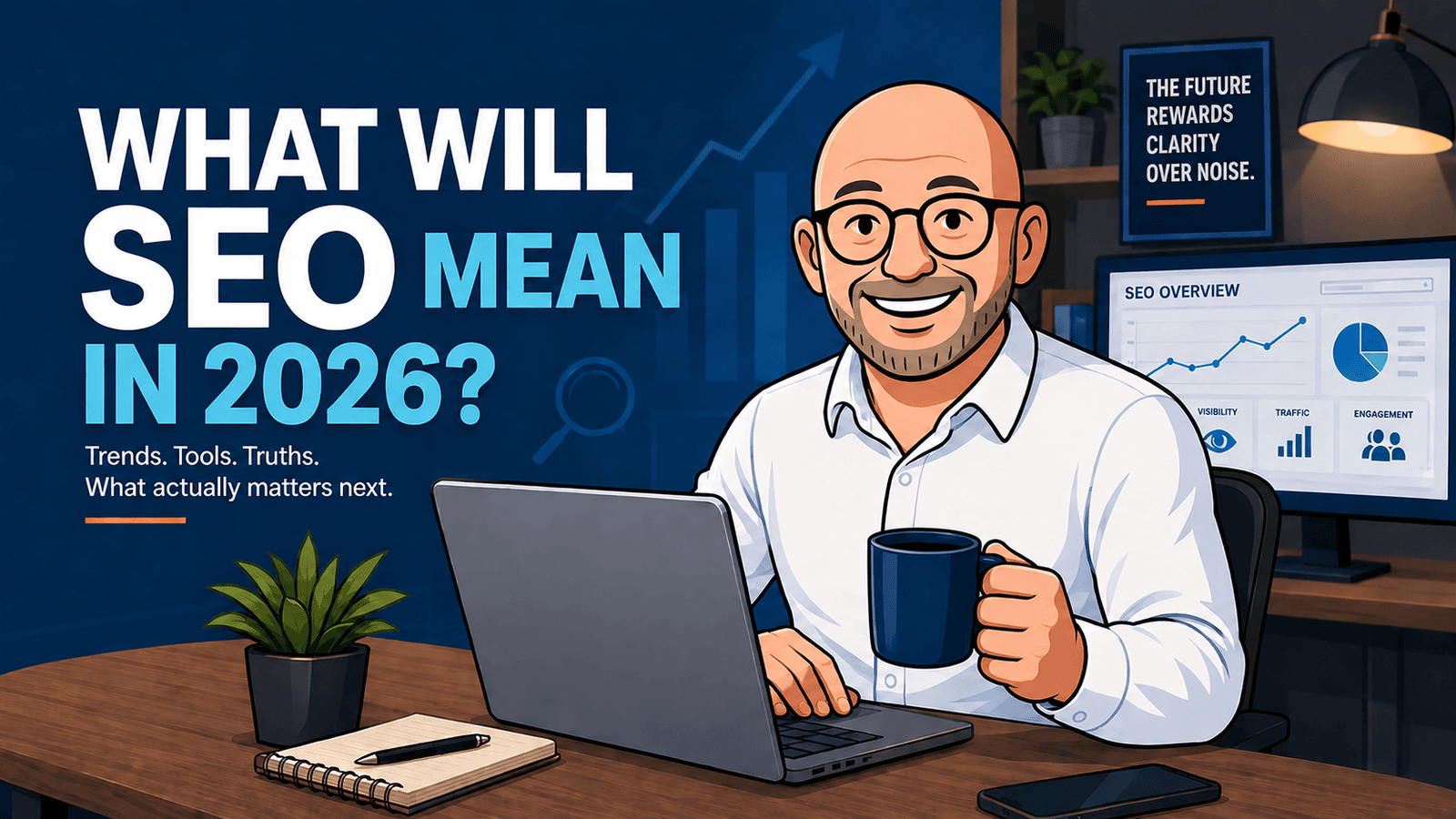
So, what will SEO mean in 2026?
It will mean being findable wherever people search.
That might be Google. It might be Maps. It might be an AI-powered answer. It might be a directory, review platform, social result, or search feature that does not even look like traditional search anymore.
The job is no longer just to rank a page.
The job is to make your business clear, trusted, consistent, and easy to recommend.
That means structured data, managed profiles, accurate local information, helpful content, and a consistent story about who you are and what you do.
At KickstartSEO, we are already preparing clients for that future. Not by panicking. Not by chasing every shiny object. And definitely not by declaring SEO dead for the 947th time.
We are helping businesses stay visible now while getting ready for what comes next.
Can We Help?
Many people end up on our blog because their SEO is not working the way they hoped, and they are trying to work out what to do next.
Sound familiar?
If 2026 search feels messy, you are not imagining it.
The sensible move is to get your website, Google Business Profile, content, and wider online presence working together now, before the next round of search changes turns up and starts moving the chairs again.