

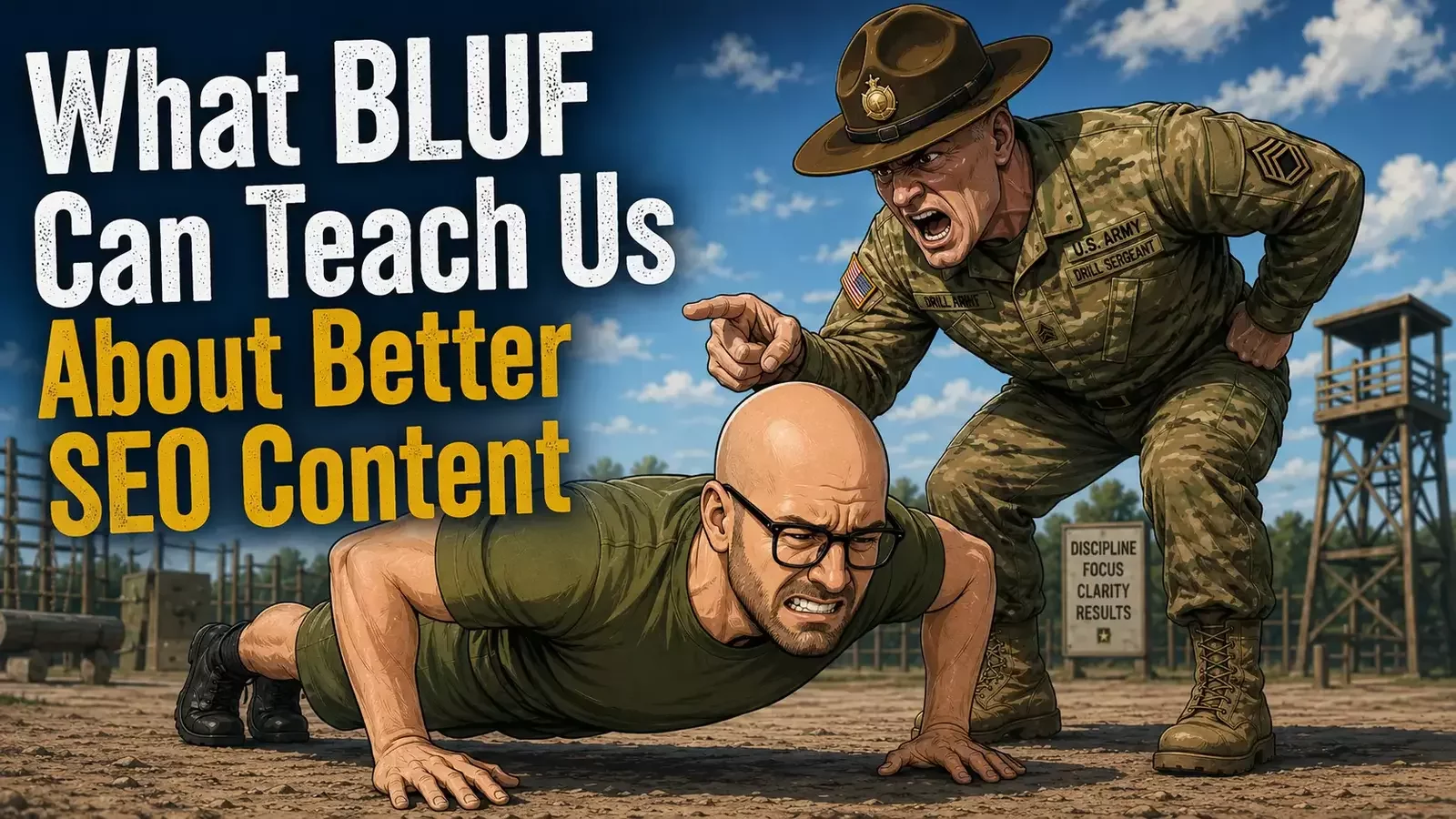
I started my adult life in the Army. It probably saved my life and certainly put me on a better path. Through that life, I met my wife, learnt skills I still use today, travelled to places I would never otherwise have visited, and became much of the person I am now.
Some Army lessons were quite specific. I have found surprisingly few civilian uses for marching in a straight line and rolling my socks to a particular standard.
Others have stayed useful throughout my life. One of those is BLUF: Bottom Line Up Front.
While the last thing SEO needs in 2026 is another acronym, this one actually matters. I am not the first person to connect BLUF with SEO, but I would wager this is the first time many small business owners have heard of it.
That matters because many websites already contain useful content that no longer presents its answers clearly enough for modern search. BLUF gives us a practical way to improve it without throwing away the rankings and visibility it has already earned.
What's inside? (TL;DR)
BLUF means Bottom Line Up Front: give readers the useful answer first, then provide the explanation and evidence.
This article shows how that Army lesson can improve new content, refresh older pages, and make information easier for people, search engines and AI tools to understand.
Useful Sections
Estimated reading time:
10 minutes
What Does BLUF Mean?
BLUF means Bottom Line Up Front.
It is the practice of stating the conclusion, recommendation or most important information first, then providing the explanation, evidence and supporting detail.
US Army guidance describes effective writing as concise, organised and direct, with the main point placed at the beginning.
Another phrase I heard regularly during my Army days was: Don’t tell me how to build a watch. Tell me what time it is.
It did not mean the workings of the watch never mattered. Sometimes they mattered a great deal. It meant that when someone asks for the time, you give them the time before delivering a lecture on springs, gears and Swiss manufacturing.
The answer comes first. The explanation follows when it is needed.
That is BLUF.
On a website, BLUF might take the form of a TL;DR box, a direct opening paragraph or simply a strong first sentence beneath each heading. It can guide new content, but it can also improve older pages that contain useful information in the wrong order.
What Does BLUF Have to Do With SEO?
BLUF helps SEO content because readers and search systems should not have to hunt through a page to discover what it is saying.
Someone arrives on a page because they have a question, a problem or a decision to make. The content should show them reasonably quickly that they have reached the right place.
Instead, many websites make visitors sit through a ceremonial opening.
You ask how long SEO takes and receive three paragraphs explaining that the digital landscape is constantly evolving. You ask how much a service costs and are told every business is unique. You ask whether something can be fixed and get the company’s life story.
Plenty of watch-building. Not much timekeeping.
BLUF Helps the Reader
People do not need every detail immediately. They need the main answer before deciding whether the detail is worth their time.
Imagine someone searches: How long does SEO take?
A weak answer might begin: SEO is a complex and constantly evolving discipline involving many interconnected factors, including your industry, competition, website authority and wider digital presence.
None of that is necessarily wrong. It simply has not answered the question.
A BLUF answer would begin: Most businesses should expect meaningful SEO progress to take several months, although the timing depends on where the website is starting, the competition and the work being carried out.
Now the reader has the bottom line.
The article can then explain what meaningful progress means, why timings differ, what affects results and why anyone guaranteeing first place by next Tuesday should probably be shown the door.
Answering first does not end the conversation. It earns the right to continue it.
BLUF Helps Search Engines Understand the Page
Clear content is easier to interpret.
When the main subject and answer appear early, search engines can more easily understand what the page covers and whether it may answer a particular query.
That does not mean Google has a secret BLUF bonus hidden in its ranking systems. Writing “Bottom Line Up Front” at the top of a page does not earn extra SEO points. Acronyms are not magic spells, however enthusiastically some marketers collect them.
The value comes from what BLUF forces the writer to do:
identify the real question
decide what the answer is
state that answer clearly
support it with useful information
remove background that delays the point
Those are good content habits whether the reader arrives through Google, an AI search tool, social media or another website. They also fit Google’s guidance on creating helpful, reliable, people-first content rather than material written mainly to manipulate search rankings.
BLUF Can Support GEO and AI Search Visibility
GEO stands for generative engine optimisation. In plain English, it means making content easier for AI-powered search and answer tools to understand and potentially use.
These systems can pull useful passages from a page rather than treating the whole article as one long, continuous argument. That makes clear sections with direct opening statements more useful.
A section that begins with its main point and then supports it is easier to understand than one that circles the subject for several paragraphs before revealing what it meant.
Ahrefs includes BLUF among its writing frameworks for better AI visibility, recommending that writers lead with the key conclusion before providing the supporting information.
BLUF cannot force ChatGPT, Google’s AI results or any other system to use your content. Nothing can guarantee that.
What it can do is make your answer and supporting explanation easier to identify. That is sensible whether AI search becomes dominant, remains one part of the search landscape or changes shape again next Tuesday.
If the growing collection of terms is becoming more confusing than useful, our explanation of what SEO, AEO and GEO actually mean puts them into plain English.
A TL;DR Box is One Way to Use BLUF
We use TL;DR boxes on KickstartSEO blog articles because they give readers the central point quickly, then allow the rest of the article to provide the examples, detail and context.
That is one way to use BLUF, but a TL;DR box is only a format. BLUF is the wider communication principle.
You can use BLUF without a summary box. It may be as simple as writing an opening sentence that answers the reader’s question before expanding on it.
A useful TL;DR should usually give the reader:
the main conclusion
the most important supporting point
the practical implication
In other words, it should tell them the time before the article explains how the watch works.
A summary box should support clear writing, not rescue a vague article.
Use BLUF Throughout the Page
BLUF should not be confined to the introduction. It can improve individual sections, service pages, frequently asked questions, reports and ordinary emails.
Use It in the Opening Statement
The opening paragraph should make the central answer, argument or recommendation clear.
For example: BLUF helps SEO content because readers and search systems should not have to hunt through a page to discover what it is saying.
That sentence gives the reader the point. The rest of the section explains why it matters.
Use It at the Start of Each Major Section
A good heading tells the reader what the section covers. The opening sentence should then tell them what that section is trying to say.
For example: BLUF does not require short content. It requires the main point to appear before the supporting explanation.
The rest of the section can then show why.
Use It on Service Pages
Tell people what the service does, who it helps and what happens next before explaining when the company was founded, what inspired the logo or why everyone is passionate about customer satisfaction.
Your company story may matter. It probably does not matter before the visitor understands whether you can help them.
Use It in Frequently Asked Questions
Answer the question in the first sentence.
Do not begin with: That is an excellent question, and one we are asked frequently by businesses of all shapes and sizes.
It was not an excellent question. It was probably a perfectly ordinary question.
Just answer it.
Use It in Reports and Emails
Put the decision, finding or required action near the top.
A client should not need to read six paragraphs before discovering that a broken contact form is costing them enquiries.
Tell them what time it is. Then explain why the watch stopped.
Use BLUF When Updating Old Content
BLUF is not only useful when writing something new. It is also a practical way to improve older content that still contains good information but takes too long to reveal it.
Many businesses have years of content on their websites. Some of it contains real experience, useful advice and perfectly good answers, but it may have been written for an older search environment.
The answer may be buried beneath a long introduction. Important points may be scattered across several paragraphs. Headings may name a subject without clearly answering anything. The article may have been built around a keyword rather than the question behind it.
That content may still be accurate, but accuracy alone does not make it effective.
Modern search increasingly relies on systems being able to identify clear answers and connect useful passages with specific questions. Human readers are also less willing to excavate a page in the hope that something helpful eventually turns up.
BLUF gives us a practical way to bring the main answer forward, make each section easier to understand and organise the supporting detail around a clear point.
This is also why evergreen content needs more than an occasional date change. An older article may still deserve its place, but it should be reviewed to make sure its answers, examples and structure still work now.
Don’t Reinvent the Wheel
Another Army phrase that still earns its keep is: Don’t reinvent the wheel.
Using BLUF to improve old content does not mean deleting everything and starting again.
Some older pages already have rankings, visibility, backlinks and a history in search. Throwing that away because the structure now feels dated would be a poor trade.
A page that already has visibility may not need a complete rewrite. It may simply need:
a clearer opening statement
a useful TL;DR box
stronger headings
better first sentences beneath those headings
an important conclusion moved higher up the page
outdated examples or facts corrected
repetition removed
useful evidence preserved and presented more clearly
The aim is not to replace good content for the sake of appearing current. It is to help existing content work harder in a changing search landscape.
Updating an established page should begin with evidence, not enthusiasm. Preserve what is already earning visibility and improve the parts that make the answer difficult to find.
Keep the authority it has earned. Improve the way it communicates.
A Simple BLUF Process for Updating Old Content
Start by asking what question the page should answer. Then:
Identify the clearest answer already contained in the page.
Move or rewrite that answer so it appears near the top.
Add a TL;DR box if it genuinely helps the reader.
Strengthen the first sentence beneath each major heading.
Remove throat-clearing, repetition and outdated background.
Check that the evidence still supports the claims.
Preserve useful experience, links and sections that already perform well.
Record the page’s current search performance so you can judge whether the update helped rather than merely changed things.
For example, an older article might begin: Search engine optimisation has changed considerably over the years, with businesses now needing to consider many different platforms, technologies and user behaviours.
That is broad, accurate and almost entirely harmless. It is also not especially useful.
A clearer opening might be: Older website content may lose effectiveness when useful answers are buried, outdated or poorly structured for modern search and AI tools.
Now the reader knows what the article is about and why it matters. The supporting explanation can follow.
The same principle applies when planning new material. An intentional blog strategy begins with what the reader needs, not with a determination to publish another article because Tuesday has arrived.
BLUF Does Not Mean Making Everything Short
BLUF is about order, not necessarily length.
A detailed article can still contain 2,000 words. A service page may still need to explain the process, pricing, risks, alternatives and what happens next. A technical guide may require examples, evidence and careful supporting detail.
The difference is that the reader knows where the explanation is going.
BLUF does not remove the detail. It stops the detail holding the answer hostage.
There is also a difference between clear content and thin content. A one-sentence answer may be quick, but it is not always useful.
Someone asking how long SEO takes may also need to understand:
what affects the timescale
what early progress looks like
why rankings are not the only measure
what work needs to happen
what could delay results
whether SEO is the right investment for them
The opening answer gives direction. The rest of the page provides confidence, context and proof.
Most Business Content Needs Less Throat-Clearing
A lot of online content delays the useful part because writers believe a long introduction sounds authoritative.
It usually does not. It often sounds like the writer has not decided what the point is.
Consider this: In today’s increasingly competitive digital environment, businesses must navigate a wide range of complex challenges to establish a strong and sustainable online presence.
It contains plenty of words and says almost nothing.
A clearer version might be: Your website may be losing potential customers because it does not explain what you do quickly enough.
Now we have a problem worth discussing.
The clearer version is not less professional. It is simply less interested in wasting the reader’s time.
When BLUF is Not the Right Approach
Not every piece of writing needs to reveal its conclusion immediately.
A personal story may need room to unfold. A case study may work better when it takes the reader through the problem and discovery. Entertainment, humour and narrative writing often depend on timing.
Even business content can sometimes benefit from a short opening that creates context before stating the main point.
BLUF is a principle, not another rigid template to impose on every page.
Not every piece of writing needs to bark the answer before the reader has taken their coat off. But most business content could reach the point considerably sooner than it does.
The test is simple: Is the delay helping the reader, or is the writer merely warming up?
A Simple BLUF Test for Your Website Content
Choose an important page on your website and ask:
What is the main thing the visitor needs to understand?
Can they find that point in the opening paragraph?
Does each major section begin with a clear idea?
Is important information buried beneath background or boilerplate?
Could someone skim the page and still understand its argument?
Does the supporting detail prove or explain the opening statement?
Is older content still structured for the way people and search systems find answers now?
Then read the first two sentences beneath every heading. If they do not tell you what that section is trying to say, the bottom line may still be hiding somewhere near the bottom.
The Bottom Line on BLUF
BLUF will not magically improve your rankings, persuade an AI platform to quote you or rescue content that has nothing useful to say.
What it can do is make your expertise clearer.
It helps readers recognise that they have reached the right page. It helps search engines and AI tools identify the main subject and answer. It also gives businesses a practical way to improve useful older content without throwing away the visibility and authority it has already earned.
That was useful in the Army. It is useful in SEO. Frankly, it is useful almost anywhere people are busy and clarity matters.
Your website may already contain the right information. The problem may simply be that readers and search systems have to work too hard to find it.
Can We Help?
Many people end up on our blog because their SEO is not working the way they hoped, and they are trying to work out what to do next.
Sound familiar?
If your older content still has useful information but buries the answer, the solution may not be a complete rewrite.
A clearer opening, better section structure and a few sensible updates could help it work harder for both readers and modern search.