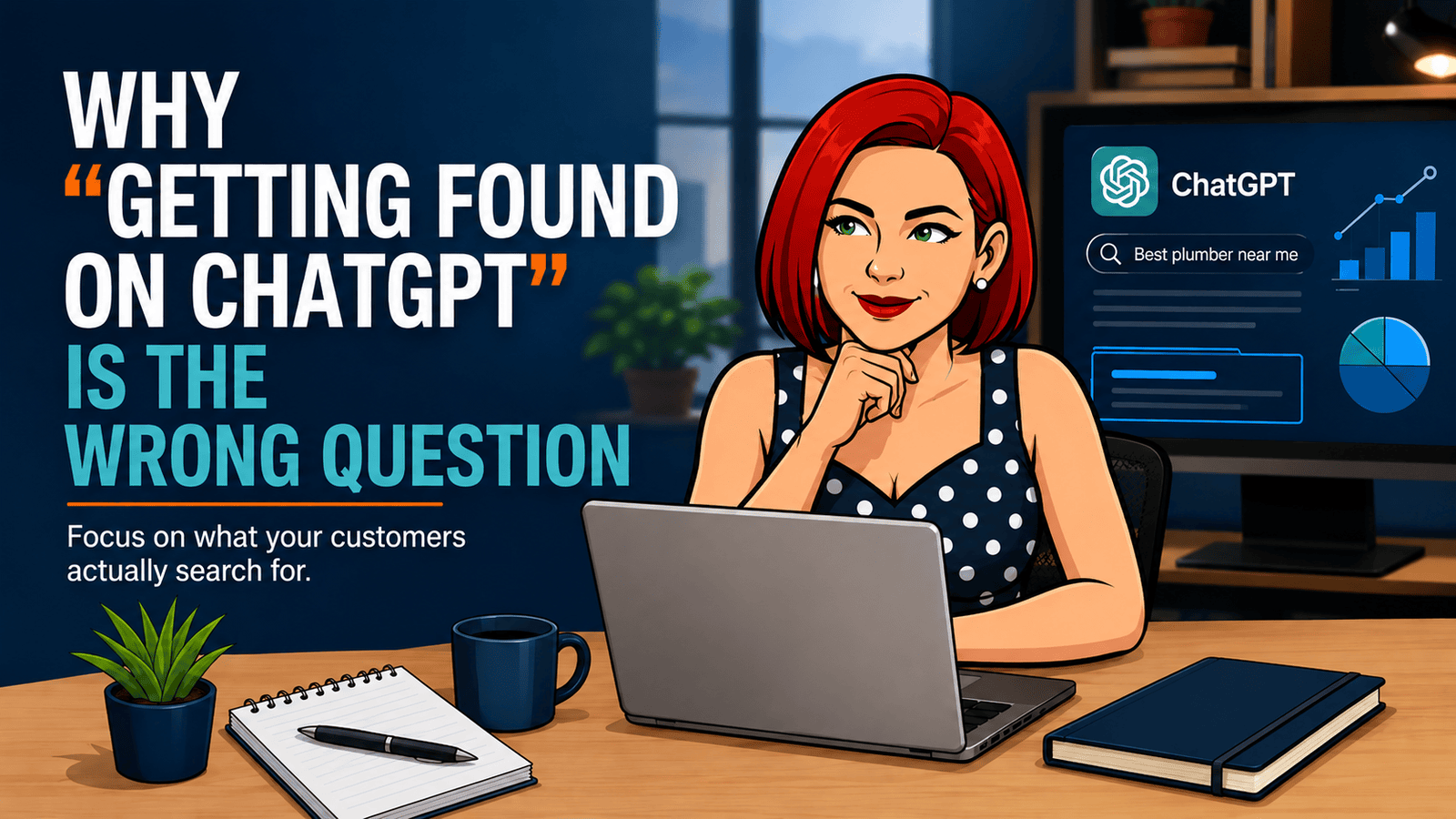
Over the past few months, a new question has started popping up in conversations with small business owners.
“How do I get found on ChatGPT?”
It usually comes with the same tone people used in the early days of Google. Curious. Slightly anxious. Hoping there’s a switch to flip before everyone else does.
I understand the instinct. But it’s the wrong question.
What's inside? (TL;DR)
This article explains why trying to “get found on ChatGPT” is the wrong way to think about AI search visibility.
The better focus is understanding customer intent, building trust, and making sure your website helps people make decisions.
Useful Sections
Estimated reading time:
4 minutes
If you’ve not already read SEO In 2026: A Sensible Manifesto For Small Businesses, it’s worth doing that first. This piece builds on that thinking rather than repeating it.
AI Doesn’t Replace Search. It Changes The Conversation
AI answer engines are good at helping people think.
They’re where someone goes to untangle an idea, explore options, or sense-check a decision. They’re strong on explanation, context, and comparison. They feel more like a conversation than a directory.
Traditional search engines still do something different. They drive action.
When people want to buy, book, compare prices, check availability, or find a local business they can actually contact, they still turn to search. They want options. They want evidence. They want somewhere to click.
Different tools. Different moments. Different intent.
Confusing those roles is where a lot of bad advice starts.
“Getting Found” Isn’t A Feature. It’s An Outcome
Here’s the uncomfortable part.
You don’t get found by optimising for a single platform or chasing the latest interface. You get found because you’ve earned enough trust to be surfaced when it matters.
Think of it like word of mouth. You don’t walk into a room and announce that you’d like to be recommended. You do good work. You explain what you do clearly. People remember you. Then your name comes up naturally.
AI systems work in much the same way. They summarise what’s already understood, referenced, and consistent. They don’t reward shortcuts. They reflect reputation.
Chasing visibility without earning trust is like polishing the sign outside a shop no one wants to enter.
The Danger Of Chasing AI Shortcuts
Every major shift in search brings the same pattern.
Someone promises a faster route. A framework. A tweak. A special format that will “guarantee” exposure.
It never lasts.
I’ve seen this cycle before. In the early days of Google, people were convinced that if they just cracked the right keyword formula, visibility would take care of itself. Pages were written for algorithms, not humans. It worked for a while. Then Google grew up, and a lot of businesses discovered their traffic had been built on sand.
Strategies built purely to please a platform are fragile. When the rules change, they collapse. The businesses that suffer most are the ones that mistake optimisation for substance.
Intent Beats Platforms Every Time
A better question than “How do I get found on ChatGPT?” is this:
What questions are my customers actually trying to answer, and where do they go at each stage?
Some are thinking problems. Some are research problems. Some are buying problems.
Your job isn’t to chase every new surface. It’s to show up consistently, with clarity, wherever those decisions are being made.
That means useful content. Plain explanations. Evidence you know what you’re doing. A website that still works when someone is ready to act.
None of that is exciting. All of it works.
A Sensible Takeaway For 2026
If you take one thing forward into 2026, make it this:
Stop asking which platform you need to please next, and start asking whether your website genuinely helps someone make a decision. Visibility is usually the result of that, not the reward for chasing it.
AI will keep evolving. Search will keep evolving. Businesses that stay grounded tend to outlast both.
That’s the long game. It isn’t flashy. But it’s reliable.
Can We Help?
Many people end up on our blog because their SEO is not working the way they hoped, and they are trying to work out what to do next.
Sound familiar?
If you’re wondering how AI search changes your SEO, the answer is probably less dramatic than the noise suggests.
Start by making sure your website explains what you do clearly, answers the questions real customers ask, and gives people enough confidence to take the next step. That’s where visibility begins, whether the visitor comes from Google, ChatGPT, or whatever shiny new thing turns up next.