

In July 2025 I did something deliberately daft to prove a serious point about SEO.
I tried to rank number one on Google for a phrase nobody searched for: “skinny bald american doing seo in bedford”.
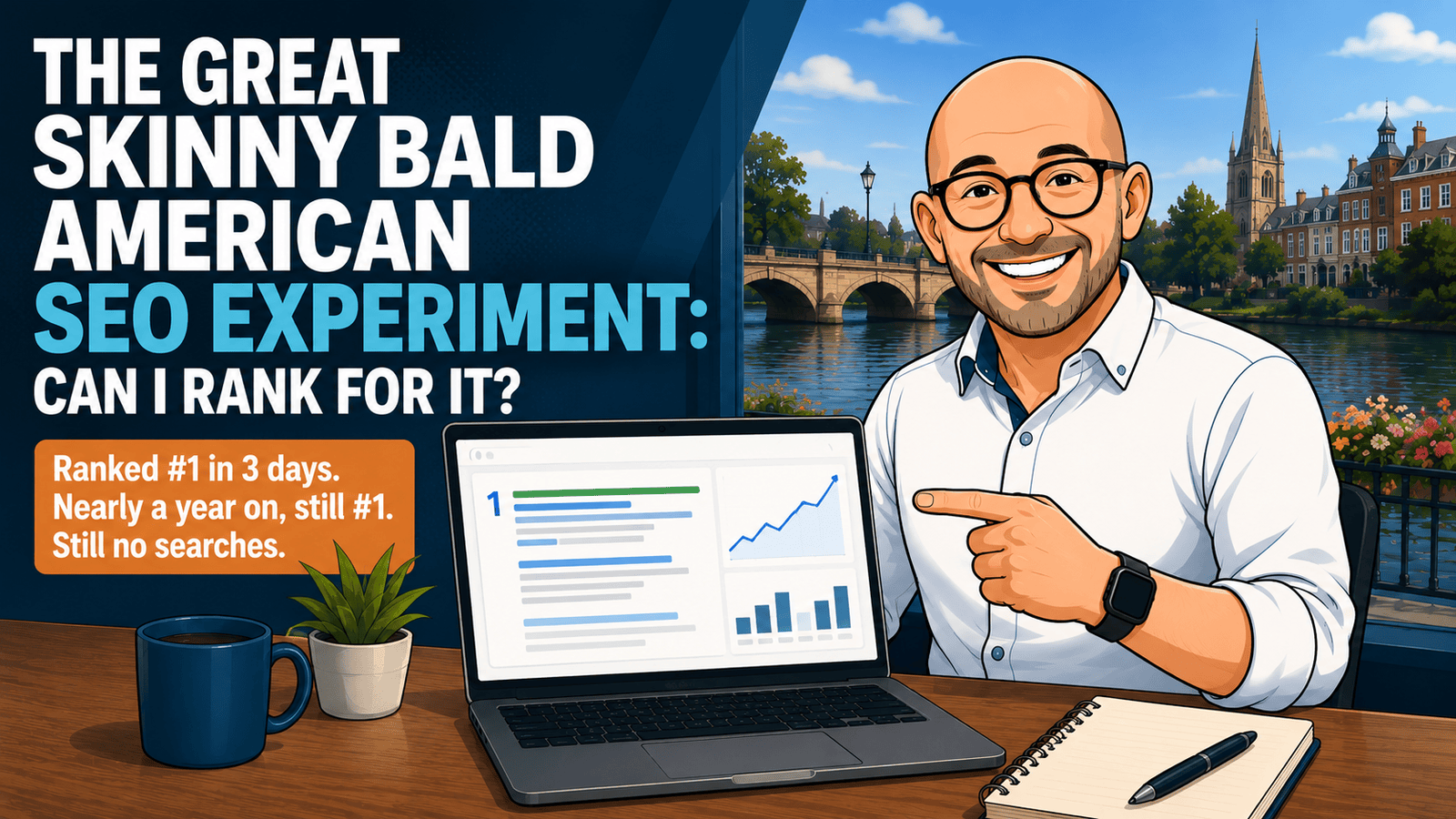
The original plan was to turn it into a multi-part experiment over 14 days. That plan fell apart almost immediately because the page ranked number one within 3 days. Not exactly the dramatic cliffhanger I had in mind.
Nearly a year later, as of 30 May 2026, it still ranks number one. And yes, almost nobody is still searching for it. Which is the whole point. Ranking first is only impressive when the keyword has real business value.
What's inside? (TL;DR)
This article revisits a daft SEO experiment with a useful lesson behind it: ranking number one is easy when nobody is searching for the phrase.
The real job is finding keywords that people actually use, then building pages that deserve to rank for them.
Useful Sections
Estimated reading time: 4 minutes
The Original Hypothesis
When I first wrote this article on 11 July 2025, the plan was simple.
I wanted to see whether I could rank number one on Google for two ridiculous phrases:
“skinny bald american doing seo in bedford”
“skinny bald american doing seo in milton keynes”
Why? Because it was a useful way to show how misleading keyword rankings can be when they are taken out of context.
The original theory was that I could hit number one for both phrases within 14 days. No massive budget. No team of writers. No dodgy link farms. Just basic SEO:
relevant content
local context
sensible internal linking
clear page structure
a website Google already understood
It was meant to be a neat little four-part series.
Google spoiled that plan by ranking the page number one within 3 days.
Very inconsiderate.
Current Status: Still Number One, Still No Searches
Nearly a year later, the phrase still ranks number one.
That sounds impressive until you remember the important bit: hardly anyone is searching for it.
That was true when I wrote the original article, and it is still true now. Nobody is waking up in Bedford thinking, “I really need a skinny bald American to sort my SEO.”
At least, not in meaningful numbers.
So yes, the experiment worked. The page ranked quickly. It stayed there. It proved the mechanics.
But it also proved the warning: ranking number one means very little if the keyword has no commercial value.
That is where a lot of SEO reports become a bit slippery. A business owner sees “ranking improvement” and naturally thinks progress is being made. Sometimes it is. Sometimes it is just a phrase nobody cares about being moved from nowhere to the top of nowhere.
Top of nowhere is still nowhere.
Why This Matters To Your Business
If you are paying for SEO and your agency keeps showing you improved rankings, ask three questions:
What keywords are we ranking for?
How many people actually search for those terms?
Are they the terms real customers use when they are ready to act?
That third question matters more than most people realise.
Some keywords look sensible from inside a business but are not how customers search. Others look boring but bring in the right traffic. A ranking report without search volume, intent, and business context is not a strategy. It is a scoreboard with half the numbers missing.
You do not need to rank for everything. You need to rank for the phrases that put you in front of the right people at the right moment.
That is the difference between vanity rankings and useful visibility.
The Real Keywords Were Always Harder
The daft phrase was easy because there was no real competition.
The meaningful phrases were a different story.
For local SEO, terms like “SEO Bedford”, “Bedford SEO”, “SEO company Bedford”, “Milton Keynes SEO”, and “SEO consultant Milton Keynes” matter far more because they connect to actual search behaviour.
Those phrases have competition. Other businesses want them. Google has more pages to choose from. The intent is clearer. The commercial value is higher.
That is why ranking for those terms takes more than a quick blog post and a funny phrase.
It needs:
strong service pages
useful location pages
clear internal links
decent content
technical basics
trust signals
ongoing improvement
In other words, actual SEO.
The experiment was never meant to prove that SEO is easy. It was meant to prove that easy rankings are not always useful rankings.
What The Experiment Proved
The experiment proved a few things.
First, Google can understand a clear page very quickly when the competition is low.
Second, basic SEO still matters. A clear title, relevant wording, a focused topic, internal context, and a crawlable website can still get results.
Third, ranking reports need context. Without search volume and intent, a ranking position is just a number wearing a nice hat.
Fourth, content can rank for very specific phrases, even when the phrase is odd, if the page is the best match available.
And finally, being number one is not the same as winning.
If the phrase does not bring visitors, enquiries, trust, or business value, it is just a shiny badge. Nice to look at. Not much use at the till.
The Lesson Almost A Year Later
Nearly a year on, the lesson is clearer than it was when I started.
Ranking number one is not the goal.
Useful visibility is the goal.
That means showing up for searches that matter to your customers, your services, your location, and your commercial reality. It means understanding the difference between curiosity searches, research searches, and buying-intent searches.
It also means being honest about what SEO can and cannot prove.
Can I rank number one for a phrase nobody searches for? Yes.
Does that make me an SEO genius? No.
Does it prove that rankings need context before anyone starts celebrating? Absolutely.
This is why keyword research should never be treated as a tick-box exercise. It shapes the whole plan. Pick the wrong phrases, and even a successful campaign can send you marching confidently in the wrong direction.
Lovely posture. Terrible destination.
What To Check In Your Own SEO
Here is the practical bit.
Look at the keywords your site ranks for now. Then ask whether they fit one of these categories:
people searching for your service
people searching in your location
people asking questions before buying
people comparing options
people ready to take the next step
If your rankings mostly sit outside those groups, you may have visibility without value.
That does not mean the work is worthless. Some informational content supports trust. Some low-volume phrases can convert well. Some niche searches matter more than they look on paper.
But you need to know why each keyword matters.
If nobody can explain that, the ranking probably belongs in the “nice, but so what?” pile.
Final Thought
The skinny bald American experiment did exactly what it needed to do.
It ranked quickly. It stayed ranked. It attracted almost no search demand. Perfectly useless, in the most educational way possible.
And that is the point.
SEO should not be about chasing the easiest number one position. It should be about earning visibility where your customers are actually looking.
Rankings matter.
But only when they matter.
Can We Help?
Many people end up on our blog because their SEO is not working the way they hoped, and they are trying to work out what to do next. Sound familiar?
If your SEO reports are full of rankings but light on useful business context, that is usually a warning sign.
We can help you separate the phrases that actually matter from the ones that look good in a report but do absolutely nothing.