

I got another one this morning.
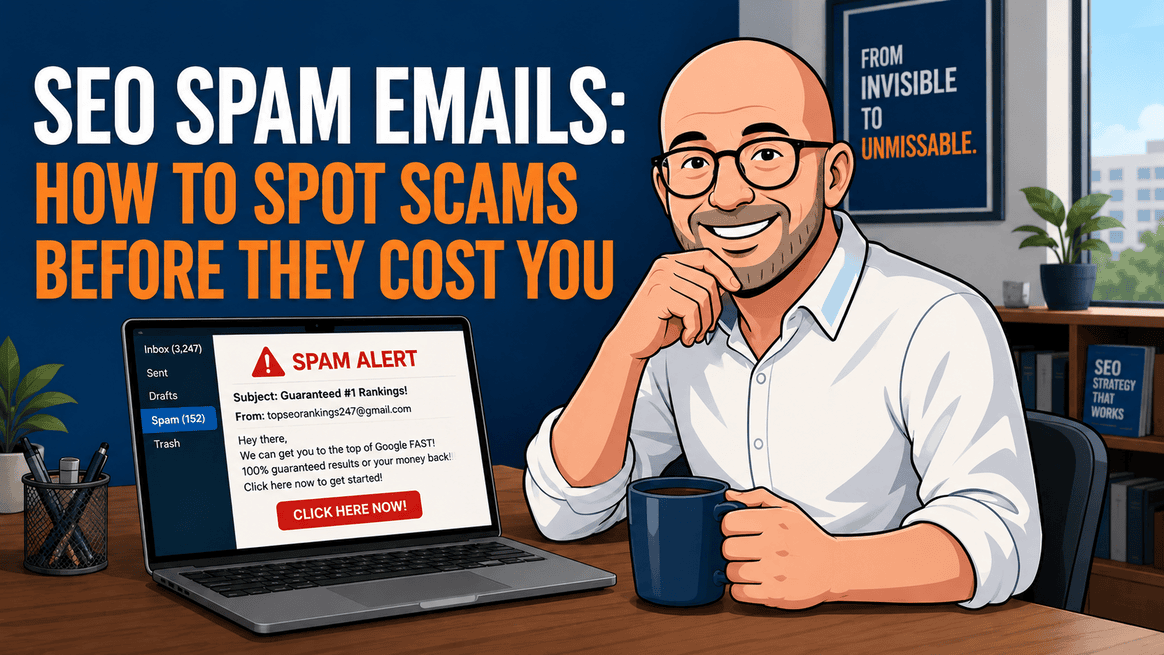
“Dear Business Owner, I noticed your website isn’t ranking on Google. I can fix that for you!”
Every day. Every damned day.
Delete. Block. Move on.
Here’s the thing. I run an SEO company. My website ranks for plenty of SEO-related searches. Yet I still get these emails daily telling me how invisible I am online.
If they cannot even check whether I already rank before sending their spam, why would I trust them with anyone’s SEO?
But I get it. When you run a small business and someone emails saying they can get you on page one of Google, it can be tempting. Especially if your website actually is struggling.
So let’s talk about why these emails are usually rubbish, how to spot the warning signs, and what to do instead.
What's inside? (TL;DR)
SEO spam emails are annoying, but they can also lead small business owners into bad decisions.
This article explains how to spot the warning signs, tell the difference between spam and real SEO help, and check your visibility properly before panic takes over.
Useful Sections
Estimated reading time: 5 minutes
The Anatomy Of An SEO Spam Email
These emails follow a predictable pattern. I’ve received thousands over the years. Yes, thousands. I counted once.
They usually include:
The fake personal touch: “I was browsing your website and noticed…” No, you weren’t. You scraped my email from somewhere and bulk-sent this to 10,000 other businesses.
The vague problem: “Your website has critical SEO issues preventing it from ranking.” Which issues? They never say. Because they haven’t actually looked.
The impossible promise: “We guarantee first-page rankings in 30 days!” Google itself cannot guarantee that. How can someone who does not even know your business make that promise?
The pressure tactic: “This offer expires in 24 hours!” Of course it does. They do not want you thinking too hard about whether this makes sense.
Last week, I received one claiming my “Bedford accountancy website” was not ranking. I do not have a Bedford accountancy website. I have an SEO company website that ranks rather well, thank you very much.
They could not even get the basic facts right.
But here’s the kicker. I do have a client in Bedford who is an accountant. Their website ranks brilliantly. So not only did the spammers get my business wrong, they missed the fact that if I did have a Bedford accountancy website, I would already know how to rank it.
Why These Emails Are Dangerous, Not Just Annoying
Look, it is not just that these emails waste your time. The companies behind them can actively damage your business.
I have seen the aftermath too many times.
Clients come to us after working with these “guaranteed rankings” companies. Their websites have been stuffed with keywords that make no sense. They have thousands of spammy backlinks from dodgy sites. Google has penalised them, and now they are genuinely invisible online.
Just last month, a new client in Milton Keynes discovered why their website was not showing up anywhere. Their previous web design team had riddled the content pages and robots.txt file with “nofollow, noindex” tags.
Nothing was being indexed.
Even Google Search Console could not index the sitemap. They had literally told Google to ignore the entire website.
That is not SEO. That is digital suicide.
The really sneaky ones do not just damage your SEO. They hold you hostage. They build your website on their platform, optimise it using their tools, then if you try to leave?
Poof. Everything disappears.
You do not own any of it.
How To Spot Legitimate SEO Outreach
Now, not every SEO email is spam. Sometimes legitimate companies do reach out.
Here is how to tell the difference:
They have actually looked at your website. Real SEO professionals will reference specific issues. “I noticed your homepage title tag is 127 characters, and Google usually truncates long titles” beats “Your SEO needs work” every time.
They understand your business. They will mention your services, your location, maybe even your competitors. They have done homework beyond scraping your email address.
They are transparent about methods. Legitimate SEO companies will explain their approach. If someone will not tell you what they will do until after you pay, run away.
They have a real business presence. Check their website. Look for case studies, team information, a physical address. Google them. If the SEO company does not rank for SEO terms in their own area, that is a red flag the size of a football pitch.
They want to understand your business. We do not take on any client without a proper assessment first. If they are not interested in understanding your business goals, they cannot help achieve them.
What To Do When You Get These Emails
First, do not panic.
Just because someone says your website is invisible does not make it true.
Here is your action plan:
Check for yourself. Google your business name. Search for your main services plus your location. Are you showing up? If yes, that email was lying.
Use free tools.Google Search Console is free and shows exactly how your website performs in search. No guessing needed. If you are not using it, set it up. It takes about 10 minutes.
Get a proper evaluation. If you are genuinely concerned about your SEO, get a real assessment from a reputable company. A proper SEO audit looks at your specific situation, not generic problems.
Trust your instincts. If it sounds too good to be true, it is. Nobody can guarantee first-page rankings. Google’s algorithm has thousands of factors. Anyone claiming they have cracked the code is either lying or about to get you penalised.
Report the worst offenders. Forward obvious scams to report@phishing.gov.uk. The National Cyber Security Centre will investigate it. It might not stop them immediately, but it helps protect others.
The Truth About Getting Found Online
Here is what those spam emails will not tell you.
Good SEO takes time, expertise, and consistent work. It is like getting fit. Despite what Instagram says, you cannot get a six-pack in seven days.
Your website needs to be technically sound. Your content needs to genuinely help your customers. You need other websites to reference yours. Your Google Business Profile needs attention.
It is not about tricks or shortcuts. It is about doing things properly.
I have been doing this since 1995, before Google even existed. I have seen every trick, every shortcut, every “guaranteed ranking” scheme come and go.
You know what still works?
Creating a website that serves your customers well and making sure search engines can understand it.
That is not sexy. It does not fit in a spam email.
But it works.
When You Actually Need SEO Help
Sometimes those spam emails arrive at exactly the wrong time. You are genuinely struggling with visibility, wondering why competitors keep showing up, and thinking maybe, just maybe, this email is the answer.
If you are really not showing up in search results, if competitors you know you are better than are stealing your customers, if your website feels like that tree falling in the empty forest, you probably do need help.
But please, do not reply to those emails.
Find someone reputable. Check their credentials. Ask for references. Make sure they will explain what they are doing and why. Ensure you will own everything they create.
Get someone who sees your success as their success.
The Email I Got This Morning
Want to know what triggered this blog post?
Here is the email I received at 8:47 this morning, reproduced exactly as written:
“Hello, I am Rupert, a Search Engine Optimisation Specialist. Your company came up as I was searching for businesses in the your area. You appeared on page 5 of the search results. This means that you’re losing at least 70% of your potential customers to the competition and I can fix that. Are you happy with your current online presence?”
Page 5? Really, Rupert?
I literally run an SEO company. My website gets found by the people who need to find it. I know this because, wait for it, they keep hiring me.
Our website fitness is doing just fine, thanks.
The real clue that Rupert is not a genuine opportunity for me? He has not actually looked at my website. He knows nothing about me. If he did, he would not be sending me this email.
If you sold used golf balls, I would not send you an email offering to sell you used golf balls. I will be honest, I lose my own golf balls before I ever have a chance to sell them. But I needed an analogy here to make my point, and this fit.
Rupert does not care about facts. He probably sent the same email to every business in Bedford, hoping someone bites. Someone panics. Someone hands over their credit card details to fix a problem that might not even exist.
Do not be that someone.
A Quick Reality Check
Here is a fun fact.
Even businesses with excellent SEO still get these spam emails.
Why?
Because the spammers do not actually check if your SEO is working before hitting send.
I run an SEO company and get them daily. My clients, whose websites rank brilliantly, get them too. One client forwarded me a spam email claiming their website was “invisible on Google”. They were actually ranking number one for their main keywords and getting more enquiries than they could handle.
These emails mean nothing about your actual SEO performance.
They are fishing expeditions, cast wide in the hope of catching someone who will panic and pay.
If you want to know how your SEO is really performing, check your actual results.
Are you getting enquiries? Is your phone ringing? Are the right customers finding you? Look at your real metrics: traffic, enquiries, sales.
Those are the numbers that matter, not what some random email claims.
What Should You Do Right Now?
If you are worried about your online visibility, genuinely worried, not just because Rupert emailed you, here is what actually helps:
Check your current rankings using Google Search Console or by searching for yourself.
Fix the basics, such as your Google Business Profile. It is free and it works.
Create content that helps your customers instead of trying to trick Google.
Get a proper website evaluation from someone who will meet you and understand your business.
And next time you get one of those emails?
Delete it. Block the sender. Move on with your day.
Because here is the truth. The companies sending those emails are not interested in your success. They are playing a numbers game. Send enough emails, scare enough people, and someone will pay.
You deserve better than that.
Your business deserves better than that.
Can We Help?
Many people end up on our blog because their SEO is not working the way they hoped, and they are trying to work out what to do next.
Sound familiar?
If spammy SEO emails have made you question whether your website is actually working, do not trust Rupert and his magic page-one promises.
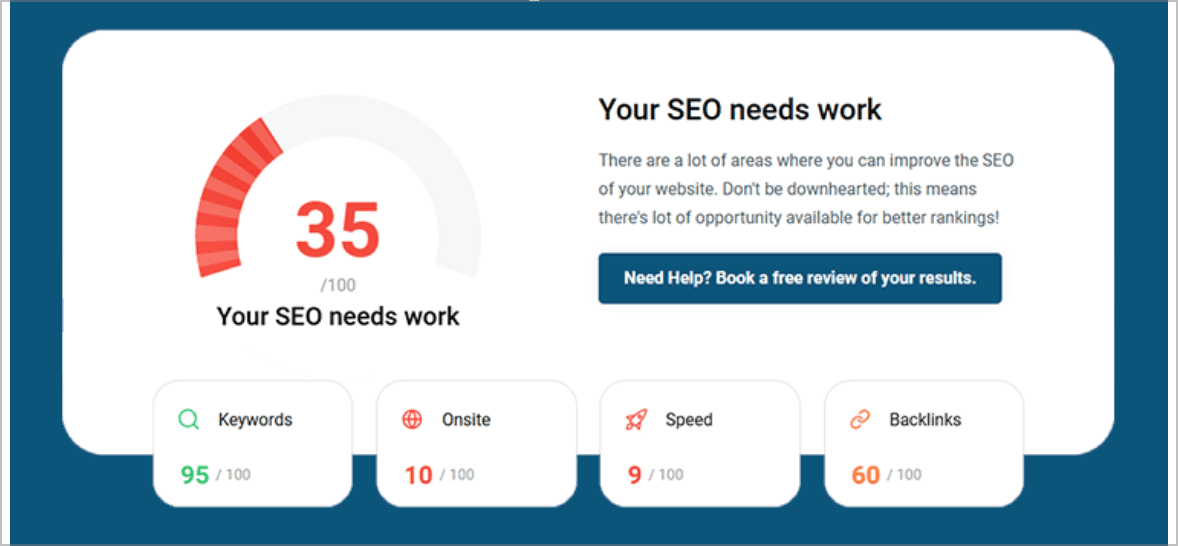
Get the facts first. A proper audit will show whether there is a real visibility problem, a technical issue, or just another chancer trying his luck in your inbox.