

“Your impressions are down.”
That sentence can make a business owner’s stomach drop faster than a dodgy website after a bad plugin update.
But lower impressions do not always mean SEO is failing. Sometimes they mean the opposite: your website is being shown for fewer weak searches and attracting more of the people who actually matter.
This article came from a real client conversation, a brief moment of panic, and one very useful reminder: SEO metrics only help when you know what story they are actually telling.

What's inside? (TL;DR)
A drop in impressions can look worrying, but it does not always mean your SEO is failing.
This article explains why better traffic, stronger engagement, and more clicks often matter more than being shown for every loose-fit search under the sun.
Useful Sections
Estimated reading time: 4 minutes
The Dashboard That Got Me Fired
Take a look at that dashboard image. Those are not numbers we made up or metrics we control. That is straight from Google Analytics and Google Search Console, the independent scorekeepers of the internet.
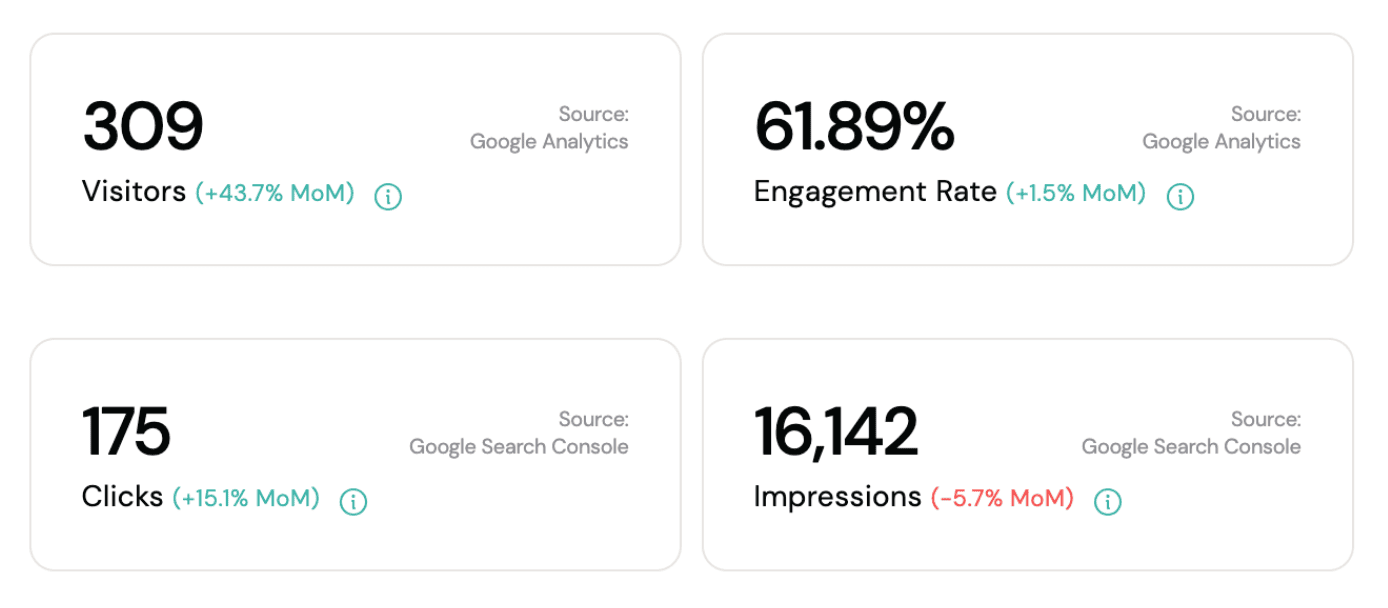
Here is what she saw:
Visitors: 309, up 43.7% month on month
Engagement Rate: 61.89%, up 1.5% month on month
Clicks: 175, up 15.1% month on month
Impressions: 16,142, down 5.7% month on month
Google’s own data. Cold, hard, unmanipulated facts.
She fixated on that one red number. The minus sign. The drop.
“My impressions are down! You’re not doing your job!”
Look, I get it. Red numbers feel like failure. But here is the thing: sometimes dropping impressions is exactly what you want.
Let’s Decode These Numbers, Because They Confuse Everyone
Before I explain why I got un-fired, let’s clarify what these metrics actually mean.
Visitors: Real humans who actually came to your website. Not robots, not accidental clicks. People who typed your URL or clicked your link and landed on your site. This is the “bums on seats” metric.
Engagement Rate: The percentage of visitors who did not immediately run away screaming. They clicked around, read things, maybe filled out a form. High engagement means people find your site useful. Low engagement means they are hitting the back button faster than you can say “bounce rate”.
Clicks: How many times people clicked your link in Google search results. Out of everyone who saw your listing, these brave souls decided you looked interesting enough to visit.
Impressions: Every time your website appears in search results. Someone searches, Google shows your site in the list, and that is an impression. Whether they notice you or not.
The Plot Twist That Saved My Job
“Hold on,” I said. “Let’s zoom out a bit.”
One month does not a trend make. So we pulled up her data from the same time last year, about 60 days after she first hired us.
Last year, same 30-day period: 3,401 impressions.
This year: 16,142 impressions.
That is a 374% increase year on year. The trend was not down at all. It was stratospheric.
“But... but it dropped 5.7% from last month!” she protested.
Here is the thing about data. Sometimes you need a different angle to see the clearest picture. Looking at month-to-month changes is like judging your fitness by how much you weigh after Christmas dinner. Sure, it is data. But it is not the whole story.
What Actually Caused The Drop
She wanted to know why impressions dipped. Could be competitors upping their game, but more likely? A change we made to her keyword and content strategy.
We had made a strategic shift 45 days earlier, removing 10 keyword phrases and adding 12 new ones. Her content was tweaked to support that shift. We deliberately stopped chasing impressions for searches that would never convert.
This is exactly what Norman, our AI strategist, does best: identifying which keywords actually drive business versus those that just inflate vanity metrics.
Think of it as switching from a scattergun to a sniper rifle. Sure, the scattergun makes more noise. But the sniper hits the target.
Why Her Dropping Impressions Were Actually Brilliant News
When I walked her through what was really happening, the full picture emerged.
Here is the fitness analogy that finally made it click for her. If you lose a kilo of fat, that is good. If you lose a kilo of muscle, that is bad. Both show up as “weight loss” on the scales, but they are completely different stories.
Same with impressions. Losing irrelevant impressions, the fat, while gaining targeted visitors, the muscle, is exactly what you want. The scales might show a drop, but you are getting stronger.
Before our work:
Ranking for lots of irrelevant keywords
Showing up in searches that would never convert
Getting impressions from people who would never become clients
Wasting Google’s time, and patience, with poor relevance
After our work:
Focused on keywords that actually matter to her business
Showing up for searches from genuine prospects
Getting fewer but much better impressions
Building Google’s trust with improved relevance
Think of it like dating. Would you rather get 1,000 matches with people completely wrong for you, or 50 matches with people who actually share your interests?
The Numbers That Actually Matter
While she was panicking about impressions dropping 5.7%, here is what was really happening.
Visitors up 43.7%: Real people were actually visiting her website, not just scrolling past in search results.
Engagement rate up 1.5%: Those visitors were sticking around, reading content, and exploring services. They were interested.
Clicks up 15.1%: More people were choosing her website over competitors in search results.
We had transformed her from the SEO equivalent of a billboard in the desert to a shop on the high street. Fewer people driving past, but the ones who did actually came inside.
The Happy Ending: My Job Back
After 10 minutes of explaining this, she got it. The lightbulb moment came when she realised we had actually improved her SEO by reducing those vanity impressions.
“So... I’m getting the right people now?”
Exactly.
“And they’re actually interested in what I do?”
Bingo.
“And that’s why my phone’s been ringing more?”
Now you’re getting it.
Not only did I get un-fired, but she apologised for the panic. By the end of our call, she was laughing about it.
“I nearly fired you for doing exactly what I hired you to do!”
That is the thing about SEO metrics. They can lie if you do not know how to read them.
The Lesson For Your Business
Stop chasing impressions. Start chasing customers.
If your impressions drop but your visitors, engagement, and clicks go up, crack open the champagne. You are doing SEO right.
Here is what to watch instead:
Quality of traffic: are visitors actually interested?
Engagement metrics: do they stick around?
Conversion indicators: are they taking action?
Revenue impact: is your phone ringing more?
Mad concept, right? Sometimes less is more.
Your SEO Reality Check
Look at your own metrics. Are you celebrating big impression numbers while your phone stays silent? Or are you focused on the metrics that actually pay the bills?
If you are drowning in impressions but starving for customers, we need to talk. Our Optimiser AI service uses Norman to continuously monitor and adjust your strategy, making sure you are attracting the right visitors, not just any visitors.
Can We Help?
Many people end up on our blog because their SEO is not working the way they hoped, and they are trying to work out what to do next. Sound familiar?
If your SEO reports are full of numbers but you are still not sure what they actually mean, that is where we can help.
We will separate the useful signals from the dashboard noise, show you what deserves attention, and tell you whether your SEO is genuinely improving or just doing interpretive dance in Google’s spreadsheets.