

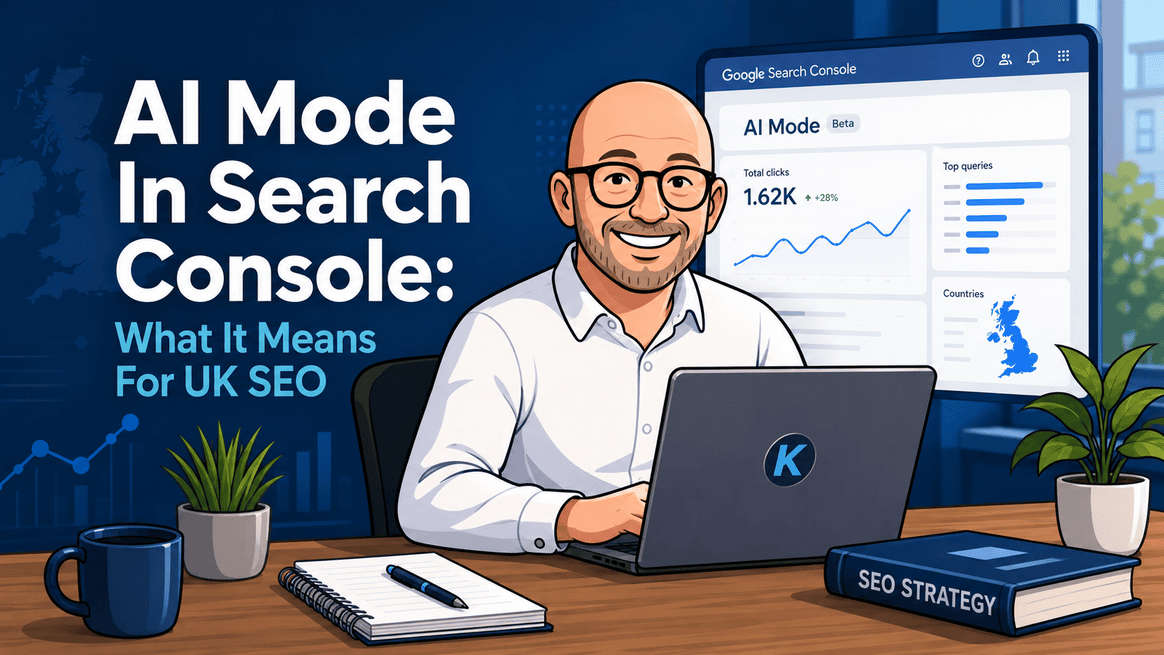
Google quietly dropped a fairly important update: AI Mode data is now being tracked in Search Console.
That sounds useful, and it is. Sort of.
The awkward bit is that Google is not giving AI Mode its own neat little reporting area. Instead, the data is being mixed into regular web search performance, which means clicks, impressions, and position data may start getting messier.
For UK businesses, this matters because AI search is no longer some distant “one day” problem. Google is building it into search itself. The question is not whether AI search matters. It is whether your website is ready to be found when search starts behaving differently.
What's inside? (TL;DR)
Google has started counting AI Mode activity inside Search Console, but it is not separating that data cleanly from regular web search.
This article explains what changed, why the reporting may become harder to read, and what UK businesses should do now rather than flapping about later.
Useful Sections
Estimated reading time: 5 minutes
What Google Announced And Why It Matters
Google updated its Search Console documentation on 16 June 2025, confirming that AI Mode data now counts towards Performance reports.
This is not just a technical update. It is Google acknowledging that AI search is now part of the search landscape.
AI Mode is Google’s interactive AI-powered search experience. Instead of simply showing a standard list of blue links, it can break a question into subtopics, search for several related ideas at once, and create a fuller answer with supporting sources.
Here is what changes:
Clicks from AI Mode links now count as clicks in Search Console
Impressions can be recorded when your page appears in an AI Mode response
Position data is counted differently, with each AI Mode element getting its own position
That last point matters. AI Mode is not measured in exactly the same way as a standard search result, which means your Search Console data may start telling a more complicated story.
Search reporting was clearly not messy enough already.
The Catch Nobody Should Ignore
Google is not giving AI Mode its own clean reporting filter.
Instead, AI Mode data is reported inside the normal Web search type in Search Console. That means AI Mode clicks, impressions, and position data are mixed in with regular search performance.
No separate tab. No clean breakout. No neat “show me AI Mode only” button.
That makes it harder to understand exactly how AI Mode is affecting your pages. If your clicks, impressions, average position, or click-through rate start shifting, AI Mode could be part of the reason. Or it could be something else entirely. Helpful, in the same way a chocolate teapot is technically still a teapot.
There was also an early tracking issue where some AI Mode visits were not passing referral data properly and appeared as direct traffic in Google Analytics. Google described this as a bug, but it still shows the wider problem: AI search measurement is developing, and businesses should not expect perfect clarity yet.
Why This Validates A Dual-Focus SEO Strategy
We have been saying for a while that businesses need to do two things at once:
Keep performing in traditional Google search
Prepare properly for AI-driven search
This update supports that approach.
Traditional Google search still matters enormously. Most people still use it, and UK businesses cannot afford to abandon what is working today because something shiny has appeared over the hill.
But AI search is not theoretical anymore. It is being built into Google’s own search experience, and Search Console is now reporting it, even if the reporting is not as clean as we would like.
The practical answer is not panic. It is preparation.
Good SEO foundations still matter: clear content, useful answers, strong structure, relevant pages, technical health, and proper evidence of expertise. AI search does not make those things obsolete. It makes the weak spots harder to hide.
What AI Mode Actually Does
AI Mode is designed for more interactive, exploratory searches.
When someone asks a complex question, Google can:
Break the question into smaller subtopics
Search across those subtopics
Build an AI-generated response
Include links to supporting sources
Allow the user to ask follow-up questions
That follow-up behaviour is important.
A user might start with a broad question, then narrow it down with follow-ups. Each follow-up can act like a new search query, creating more chances for different pages, sources, and answers to appear.
For businesses, this means content needs to support the whole journey, not just one isolated keyword. Thin pages built around a single phrase are going to struggle. Proper pages that answer real questions clearly have a much better chance of being useful.
Why The Numbers Should Get Your Attention
AI search can reduce clicks because the answer may appear directly inside the search experience.
That does not mean websites are finished. It means the value of being chosen as a supporting source may become more important, while the old habit of judging everything by simple ranking positions becomes less reliable.
If an AI result gives the user enough information, they may not click. If they do click, they may be more informed and more ready to act.
That is the trade-off.
Google has suggested that clicks from AI features may be higher quality. Maybe they are. The awkward bit is that if AI Mode data is mixed into regular Search Console data, it becomes harder to prove cleanly.
So yes, watch the numbers. But do not worship them blindly. Data without context is just a spreadsheet having a little lie down.
What This Means For Your Business
Right, let’s cut through the waffle.
If you run a UK small business, this update means four things.
First, your Search Console data may become harder to interpret. Sudden changes in click-through rate, impressions, or average position may not mean your SEO has failed. They may reflect how AI Mode is changing the search results.
Second, position tracking becomes more complicated. Your page might appear in one position in an AI Mode result and somewhere different in regular search. A single average position number may not tell the full story.
Third, content depth matters more. AI Mode is more likely to reward useful, well-structured content that answers questions properly. Pages written purely to tick a keyword box are not going to age well.
Fourth, follow-up questions matter. People do not always search once and stop. They refine, compare, question, and dig deeper. Your content needs to support that behaviour.
How To Prepare Your Website
Do not panic. Start with the sensible stuff.
Check your Search Console data regularly. Look for unusual patterns in impressions, clicks, click-through rate, and average position. Do not jump to conclusions from one odd movement, but do watch for trends.
Create content that answers real questions properly. If your page skirts around the topic, avoids the difficult bits, or gives a flimsy answer, it is unlikely to perform well in either traditional search or AI-driven search.
Structure your content clearly. Use sensible headings, answer specific questions, and organise information in a way humans can follow. If a person has to work too hard to understand your page, an AI system may not find it much easier.
Track engagement as well as clicks. If fewer people click but those who do spend more time on the site, view more pages, or make better enquiries, that matters.
Prepare before AI Mode fully rolls out in the UK. Waiting until everyone else notices is rarely a winning strategy. That is how businesses end up saying “we should probably do something about this” six months after the horse has bolted, joined LinkedIn, and started posting thought leadership.
The Bottom Line
Google adding AI Mode data to Search Console is not just a reporting tweak.
It is a signal that AI search is becoming part of normal search behaviour. Google would not bother counting it if it did not matter.
That does not mean traditional SEO is dead. Far from it. Strong traditional SEO is still the foundation. But the businesses that win next will be the ones that understand how traditional search and AI-driven search work together.
Being findable is no longer enough. Your website needs to be clear, useful, trustworthy, and structured well enough to be understood in more than one kind of search experience.
The Truth Google Buried In The Documentation
There is a line in Google’s documentation that every business owner should understand:
Meeting the requirements and following best practice does not guarantee that Google will crawl, index, or serve your content.
That is not new, but it is worth repeating.
You can do many things right and still not get the visibility you expected. That is why nobody honest should guarantee specific rankings, instant domination, or magic results.
SEO has never been about certainty. It is about improving your odds through better structure, better content, better technical health, and better usefulness.
Not as glamorous as a “secret ranking hack”, granted. But considerably less daft.
What Should You Do Right Now?
First, do not waste time trying to separate AI Mode data in Search Console. You cannot currently do it cleanly.
Second, focus on overall performance trends. Look at the broader direction of travel rather than panicking over isolated movements.
Third, make your website more useful. Answer questions properly. Explain things clearly. Show experience. Build pages that deserve to be used as sources.
Fourth, keep traditional SEO strong. Your customers are still using Google today, even while Google itself is changing.
Finally, be very wary of anyone promising guaranteed rankings in an AI-shaped search landscape. Google itself is making the reporting more complex, not less.
The sensible move is to get your site ready for both worlds: the search people use now, and the search behaviour that is already starting to arrive.
What Google Announced And Why It Matters
Google updated its Search Console documentation on 16 June 2025, confirming that AI Mode data now counts towards Performance reports.
This is not just a technical update. It is Google acknowledging that AI search is now part of the search landscape.
AI Mode is Google’s interactive AI-powered search experience. Instead of simply showing a standard list of blue links, it can break a question into subtopics, search for several related ideas at once, and create a fuller answer with supporting sources.
Here is what changes:
Clicks from AI Mode links now count as clicks in Search Console
Impressions can be recorded when your page appears in an AI Mode response
Position data is counted differently, with each AI Mode element getting its own position
That last point matters. AI Mode is not measured in exactly the same way as a standard search result, which means your Search Console data may start telling a more complicated story.
Search reporting was clearly not messy enough already.
The Catch Nobody Should Ignore
Google is not giving AI Mode its own clean reporting filter.
Instead, AI Mode data is reported inside the normal Web search type in Search Console. That means AI Mode clicks, impressions, and position data are mixed in with regular search performance.
No separate tab. No clean breakout. No neat “show me AI Mode only” button.
That makes it harder to understand exactly how AI Mode is affecting your pages. If your clicks, impressions, average position, or click-through rate start shifting, AI Mode could be part of the reason. Or it could be something else entirely. Helpful, in the same way a chocolate teapot is technically still a teapot.
There was also an early tracking issue where some AI Mode visits were not passing referral data properly and appeared as direct traffic in Google Analytics. Google described this as a bug, but it still shows the wider problem: AI search measurement is developing, and businesses should not expect perfect clarity yet.
Why This Validates A Dual-Focus SEO Strategy
We have been saying for a while that businesses need to do two things at once:
Keep performing in traditional Google search
Prepare properly for AI-driven search
This update supports that approach.
Traditional Google search still matters enormously. Most people still use it, and UK businesses cannot afford to abandon what is working today because something shiny has appeared over the hill.
But AI search is not theoretical anymore. It is being built into Google’s own search experience, and Search Console is now reporting it, even if the reporting is not as clean as we would like.
The practical answer is not panic. It is preparation.
Good SEO foundations still matter: clear content, useful answers, strong structure, relevant pages, technical health, and proper evidence of expertise. AI search does not make those things obsolete. It makes the weak spots harder to hide.
What AI Mode Actually Does
AI Mode is designed for more interactive, exploratory searches.
When someone asks a complex question, Google can:
Break the question into smaller subtopics
Search across those subtopics
Build an AI-generated response
Include links to supporting sources
Allow the user to ask follow-up questions
That follow-up behaviour is important.
A user might start with a broad question, then narrow it down with follow-ups. Each follow-up can act like a new search query, creating more chances for different pages, sources, and answers to appear.
For businesses, this means content needs to support the whole journey, not just one isolated keyword. Thin pages built around a single phrase are going to struggle. Proper pages that answer real questions clearly have a much better chance of being useful.
Why The Numbers Should Get Your Attention
AI search can reduce clicks because the answer may appear directly inside the search experience.
That does not mean websites are finished. It means the value of being chosen as a supporting source may become more important, while the old habit of judging everything by simple ranking positions becomes less reliable.
If an AI result gives the user enough information, they may not click. If they do click, they may be more informed and more ready to act.
That is the trade-off.
Google has suggested that clicks from AI features may be higher quality. Maybe they are. The awkward bit is that if AI Mode data is mixed into regular Search Console data, it becomes harder to prove cleanly.
So yes, watch the numbers. But do not worship them blindly. Data without context is just a spreadsheet having a little lie down.
What This Means For Your Business
Right, let’s cut through the waffle.
If you run a UK small business, this update means four things.
First, your Search Console data may become harder to interpret. Sudden changes in click-through rate, impressions, or average position may not mean your SEO has failed. They may reflect how AI Mode is changing the search results.
Second, position tracking becomes more complicated. Your page might appear in one position in an AI Mode result and somewhere different in regular search. A single average position number may not tell the full story.
Third, content depth matters more. AI Mode is more likely to reward useful, well-structured content that answers questions properly. Pages written purely to tick a keyword box are not going to age well.
Fourth, follow-up questions matter. People do not always search once and stop. They refine, compare, question, and dig deeper. Your content needs to support that behaviour.
How To Prepare Your Website
Do not panic. Start with the sensible stuff.
Check your Search Console data regularly. Look for unusual patterns in impressions, clicks, click-through rate, and average position. Do not jump to conclusions from one odd movement, but do watch for trends.
Create content that answers real questions properly. If your page skirts around the topic, avoids the difficult bits, or gives a flimsy answer, it is unlikely to perform well in either traditional search or AI-driven search.
Structure your content clearly. Use sensible headings, answer specific questions, and organise information in a way humans can follow. If a person has to work too hard to understand your page, an AI system may not find it much easier.
Track engagement as well as clicks. If fewer people click but those who do spend more time on the site, view more pages, or make better enquiries, that matters.
Prepare before AI Mode fully rolls out in the UK. Waiting until everyone else notices is rarely a winning strategy. That is how businesses end up saying “we should probably do something about this” six months after the horse has bolted, joined LinkedIn, and started posting thought leadership.
The Bottom Line
Google adding AI Mode data to Search Console is not just a reporting tweak.
It is a signal that AI search is becoming part of normal search behaviour. Google would not bother counting it if it did not matter.
That does not mean traditional SEO is dead. Far from it. Strong traditional SEO is still the foundation. But the businesses that win next will be the ones that understand how traditional search and AI-driven search work together.
Being findable is no longer enough. Your website needs to be clear, useful, trustworthy, and structured well enough to be understood in more than one kind of search experience.
The Truth Google Buried In The Documentation
There is a line in Google’s documentation that every business owner should understand:
Meeting the requirements and following best practice does not guarantee that Google will crawl, index, or serve your content.
That is not new, but it is worth repeating.
You can do many things right and still not get the visibility you expected. That is why nobody honest should guarantee specific rankings, instant domination, or magic results.
SEO has never been about certainty. It is about improving your odds through better structure, better content, better technical health, and better usefulness.
Not as glamorous as a “secret ranking hack”, granted. But considerably less daft.
What Should You Do Right Now?
First, do not waste time trying to separate AI Mode data in Search Console. You cannot currently do it cleanly.
Second, focus on overall performance trends. Look at the broader direction of travel rather than panicking over isolated movements.
Third, make your website more useful. Answer questions properly. Explain things clearly. Show experience. Build pages that deserve to be used as sources.
Fourth, keep traditional SEO strong. Your customers are still using Google today, even while Google itself is changing.
Finally, be very wary of anyone promising guaranteed rankings in an AI-shaped search landscape. Google itself is making the reporting more complex, not less.
The sensible move is to get your site ready for both worlds: the search people use now, and the search behaviour that is already starting to arrive.
Can We Help?
Many people end up on our blog because their SEO is not working as they hoped and they are trying to figure out what to do next. Sound familiar?
If your Search Console data starts looking odd, the worst thing you can do is guess.
AI Mode is changing how visibility is measured, so the sensible move is to understand what your site is showing now, where the gaps are, and whether your content is clear enough for both traditional Google search and AI-shaped search results.