

If SEO feels like a never-ending to-do list, the 80/20 rule is your way out.
The idea is simple. A small number of actions usually create most of the progress. For small businesses, that often means fixing the basics before chasing advanced tactics, new tools, or whatever fresh acronym has wandered into the room wearing a lanyard.
SEO still matters. So does AI search visibility. So do answer-style results, local search, Google Business Profile, and all the other moving parts.
But the best starting point has not changed much.
What's inside? (TL;DR)
This article explains how small businesses can use the 80/20 rule to focus on the SEO actions most likely to matter first.
It covers technical blockers, priority pages, local visibility, AI search readiness, and how the KickstartSEO Toolkit helps keep the work visible.
Useful Sections
Estimated reading time:
12 minutes
Fix what blocks visibility. Strengthen the pages that matter. Make your business easy to understand, trust, and choose.
That is the 80/20 approach.
At KickstartSEO, this fits our calm, repeatable method:
Diagnose what helps or holds you back.
Build the essentials so priority pages have a better chance of winning.
Improve by reviewing results and choosing the next sensible action.
No panic. No theatre. No 94-point SEO checklist printed by someone who enjoys watching small business owners suffer.
How The 80/20 Rule Applies To SEO
The 80/20 rule says a small number of inputs often create the majority of outputs.
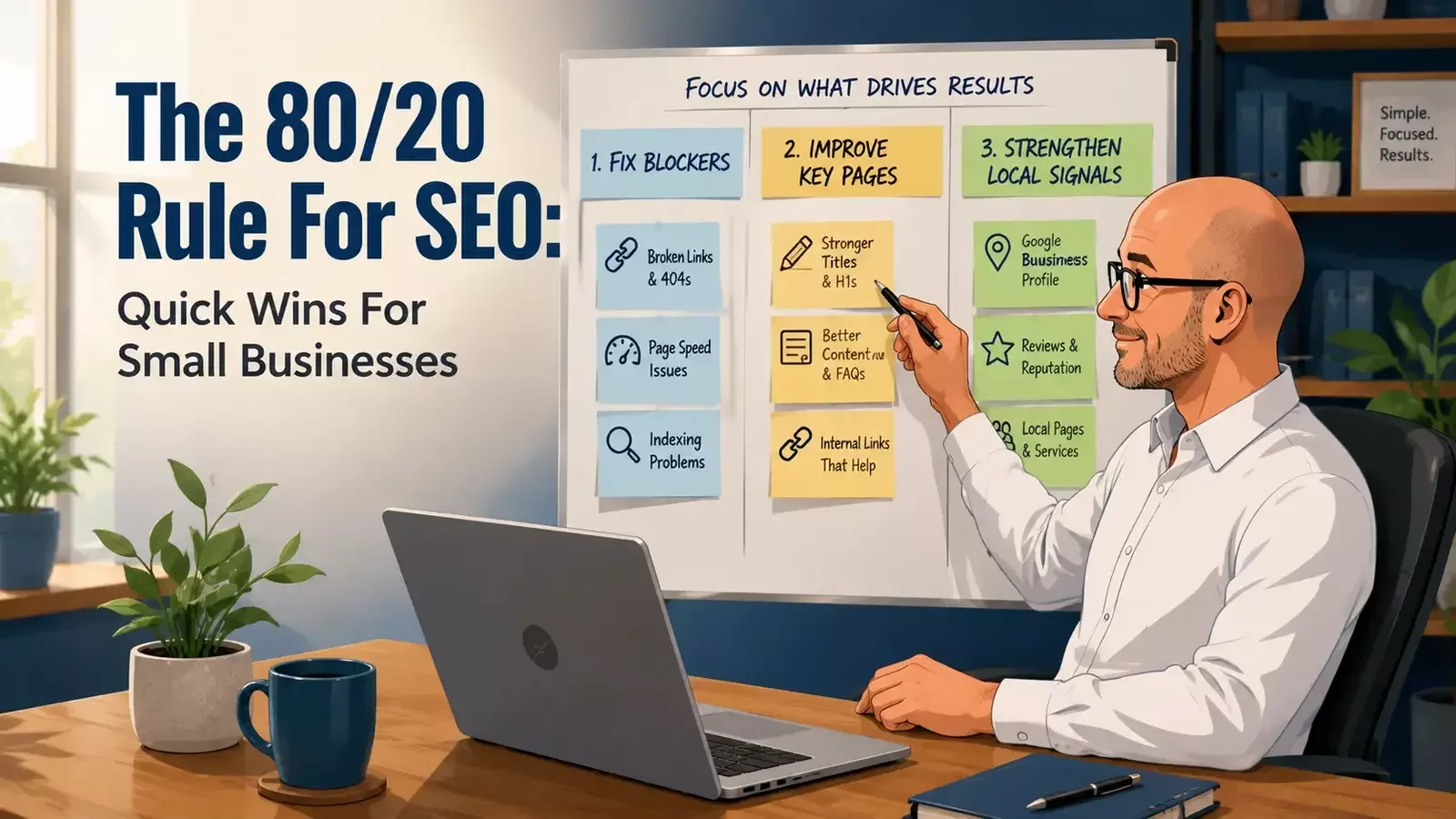
In SEO, that usually means focusing on three areas first:
technical issues that stop pages being found, crawled, indexed, or used properly
the pages most likely to generate enquiries
local visibility signals that help people and search systems understand who you are, what you do, and where you work
That applies to traditional SEO, answer-style results, and AI search visibility.
The labels may change. The underlying need is the same.
Your website has to be clear. Your pages have to answer real questions. Your business information has to be accurate. Your priority pages have to be accessible, useful, and connected to the rest of your site.
Do those things well and you give yourself a much better chance of being found and chosen.
The rest is fine-tuning.
The KickstartSEO Method: Diagnose, Build, Improve
This is the backbone of how we work with small business owners who want steady progress without wasting effort.
Diagnose: find the bottlenecks, missed opportunities, weak pages, and pages already close to better visibility.
Build: fix blockers and strengthen priority pages with clear on-page essentials, useful content, stronger internal links, and better local signals.
Improve: track what changed, learn from the results, and repeat the process on the next most valuable pages.
Norman, KickstartSEO’s AI-powered SEO strategist, supports this by analysing data, spotting patterns, and helping the team prioritise actions. A human reviews the work before anything goes live.
AI helps with speed and structure.
Human judgement stops it doing something daft at scale.
Useful distinction.
Step 1: Diagnose What Is Holding You Back
Start by finding where small fixes could make a meaningful difference.
Three places are worth checking this week.
404s And Broken Links
Use Google Search Console and your website platform to look for Not Found errors.
If an old page has value, redirect it to the best matching live page.
If the content is genuinely redundant and has no useful replacement, it may not need rescuing. Not every broken URL is a national emergency. Some are just old junk finally admitting defeat.
Slow Or Frustrating Pages
Run your homepage and main service pages through PageSpeed Insights.
Look for obvious issues:
oversized images
heavy scripts
unused widgets
slow-loading media
intrusive elements that get in the way
Do not obsess over a perfect score. The point is to improve the experience for real users, especially on mobile.
A faster, cleaner page helps visitors. That is the bit worth caring about.
Near-Miss Search Queries
In Google Search Console, look for queries where important pages are showing but not quite winning.
Positions 5 to 15 can be useful places to start because Google already understands some relevance. These pages may only need sharper titles, clearer headings, better content alignment, stronger internal links, or more useful answers.
A page sitting just outside the best visibility can often be a better use of time than creating yet another blog post because someone on LinkedIn said “content is king” in 2014 and nobody has recovered since.
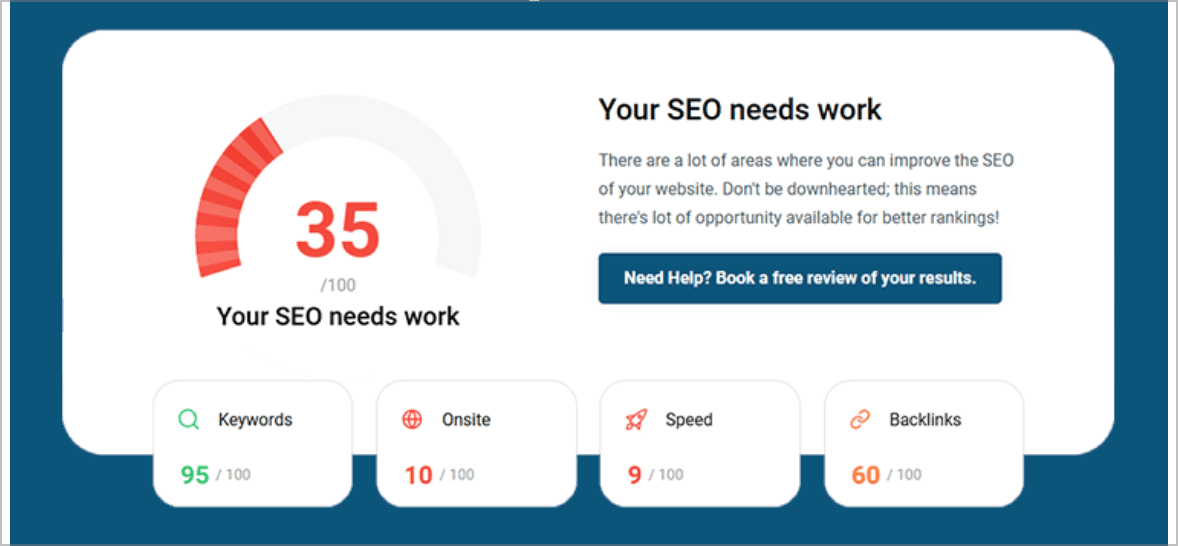
If you want a structured starting point, the free SEO audit is designed to highlight the areas worth fixing first and give you a plain-English review of what matters.
Step 2: Improve The Pages Most Likely To Generate Enquiries
Strong on-page basics are still one of the best uses of time.
Start with your homepage, your top two or three service pages, and any location pages that support real enquiries.
Here is the practical checklist.
Page Titles
Write clear, specific page titles that explain what the page is about.
Include the main service and location where it genuinely matters.
Example: Emergency Electrician In Bedford
Do not cram in every keyword variation. Google and humans both have limits. So do we all.
H1 Headings
Use one clear H1 that matches the purpose of the page.
Example: 24-Hour Electricians Serving Bedford And Nearby Villages
The H1 should reassure visitors they are in the right place. It should not read like a spreadsheet had a nervous breakdown.
Meta Descriptions
Write a clear description of the page and why someone should click.
Meta descriptions are not a direct ranking lever, and Google may rewrite snippets, but they are still useful for shaping the search result.
Example: Fast, qualified electrical repairs with clear pricing and same-day help where available. Contact our Bedford team today.
Internal Links
Add helpful links from related pages and blogs to your priority page.
Use natural anchor text.
Good internal links help users move through your website and help search systems understand which pages matter.
Do not force them. If the link feels useful to a reader, it is probably useful. If it feels like SEO confetti, sweep it up.
Image Alt Text
Describe important images in plain English.
Example: Electrician replacing a consumer unit in a Bedford terrace house
Alt text is there for accessibility and context. It is not a place to hide keywords like a squirrel hiding nuts.
Content Focus
Answer the questions buyers ask before they enquire.
For many service businesses, that means covering:
what you do
who you help
where you work
rough price signals where possible
how quickly you can help
what happens next
what makes your approach trustworthy
This helps human visitors, traditional search results, and AI-assisted search systems because the page is easier to understand.
Step 3: Tidy The Technical Basics
You do not need to become a developer to make meaningful improvements.
Start with the basics.
Compress large images.
Use modern image formats where your website supports them.
Lazy-load below-the-fold images and videos.
Remove heavy widgets you do not need.
Keep URLs short, readable, and descriptive.
Make sure your site uses HTTPS.
Check your XML sitemap is submitted in Google Search Console.
Make sure robots.txt is not blocking important pages.
This is not glamorous work.
That is usually a good sign.
A clean technical base helps search engines access your content and helps people use your website without quietly losing the will to live.
Step 4: Strengthen Local Visibility
For many UK small businesses, local visibility is where the enquiries happen.
That means your Google Business Profile and location signals need attention.
Focus on the basics first.
Categories
Choose the most accurate primary category.
Add secondary categories only if they genuinely fit. Do not add everything vaguely related to your trade. That way lies chaos and probably disappointment.
Services
List your main services clearly.
Use the language customers actually use, not internal industry wording.
If people search for “boiler repair”, do not only say “domestic heating diagnostics”. You are not writing a Victorian trade manual.
Business Information
Keep your name, address, phone number, opening hours, and website link accurate.
If you serve customers at their location, make sure your service areas are sensible and truthful.
Photos
Add real photos where possible.
Show the team, the work, the premises, vehicles, or completed projects.
Stock images can fill a gap, but real evidence usually builds more trust.
Reviews
Ask recent happy customers for reviews.
Make it easy with a direct link and a polite request.
Do not bribe people. Do not write reviews for them. Do not make it weird.
A simple request after good service is usually enough.
Local Pages
If you serve different towns or areas, your location pages should be genuinely useful.
They should not be cloned pages with the town name swapped out like a dodgy mail merge.
Each location page should explain the service, the area, the type of customers you help, and the practical next step.
What About SEO, AEO And GEO?
You will hear plenty of labels now.
SEO. AEO. GEO. AI search visibility.
Some of them are useful. Some of them are old work wearing a new hat.
For most small businesses, the practical job is still clear.
Your website needs to:
explain what you do
answer real customer questions
show experience and trust
make your services and locations easy to understand
load properly
work well on mobile
connect related pages sensibly
keep business information accurate
That helps traditional search.
It helps answer-style results.
It helps AI search systems understand your business more clearly.
The goal is not to chase every new acronym.
The goal is to make your business easier to find, understand, trust, and choose.
Step 5: Keep The Work Visible With The KickstartSEO Toolkit
One of the biggest SEO problems for small businesses is not knowing what to do.
The bigger problem is keeping the work visible once life gets busy.
If you are already a KickstartSEO client, you have access to a whole suite of tools known as the KickstartSEO Toolkit.
It is there to keep your SEO work organised, visible, and easier to act on.
The Portal brings your SEO actions, reporting, local visibility, backlinks, learning resources, and Norman’s support into one organised workspace.
The Approval Center lets you review, amend, approve, or reject recommended actions before anything moves forward.
The Onsite Optimizer helps approved website changes move from recommendation to action without endless back-and-forth.
In plain English, the Toolkit helps turn the 80/20 rule into a working routine.
You can see what needs attention.
You can see what has been recommended.
You can approve work before it goes live.
And you can keep SEO moving without trying to hold the whole plan in your head.
That matters because most small businesses do not fail at SEO because they lack good intentions.
They fail because the work gets scattered, delayed, forgotten, or buried under “we should probably do that one day”.
The Toolkit exists to stop that happening.
Step 6: How Norman Helps Prioritise The Next Move
Inside the KickstartSEO Toolkit, Norman helps decide what should happen next.
Norman, KickstartSEO’s AI-powered SEO strategist, reviews search, analytics, technical, content, and local visibility data, then helps produce a ranked list of actions.
The usual order is sensible:
Unblock first. Fix issues that stop important pages being found, loaded, or used properly.
Lift near-misses. Improve pages that already show signs of search visibility but are not quite winning yet.
Tidy overlap. Improve, merge, or remove thin pages that compete with each other.
Strengthen local visibility. Keep Google Business Profile, reviews, services, photos, and location pages accurate and useful.
Create only when needed. New content is useful when there is clear demand and a clear purpose. Publishing for the sake of activity is just typing with invoices attached.
Norman helps organise the work.
You stay in control.
Nothing goes live unless you let it.
A Simple Monthly 80/20 Plan
Here is a practical plan you can repeat every month.
Week 1: Diagnose
Check Search Console.
Find:
top 404s
pages losing impressions
pages ranking just outside stronger visibility
slow or frustrating pages
obvious indexing issues
Pick two priority pages.
Not twelve.
Two.
This is SEO, not a buffet.
Week 2: Improve Priority Pages
Update the title and H1 where needed.
Improve the opening section so visitors understand the page quickly.
Add answers to the most common buying questions.
Add two or three useful internal links from related content.
Week 3: Strengthen Local Visibility
Update your Google Business Profile services.
Add fresh real photos.
Check opening hours.
Ask three recent happy customers for reviews.
Review one location page and make it more useful.
Week 4: Tidy Technical Issues
Compress images on your most important pages.
Remove one unnecessary widget, script, or slow-loading element.
Check redirects for old URLs that still matter.
Review whether any thin or overlapping pages should be improved, merged, or removed.
Then repeat next month with the next two priority pages.
This is how SEO progress usually happens.
Not in one heroic weekend.
Not from buying another tool.
Not from shouting at your website and hoping Google overhears.
Small, focused improvements. Repeated properly.
FAQs
What Is The 80/20 Rule For SEO?
The 80/20 rule for SEO means focusing on the small number of actions most likely to create meaningful progress. For small businesses, that usually means fixing technical blockers, improving priority service pages, strengthening internal links, and keeping local business information accurate.
How Can A Beginner Start SEO?
Start with diagnosis.
Set up Google Search Console. Check whether your important pages are indexed. Look for broken pages, slow pages, and search queries where your site already appears. Then improve your most important pages one at a time.
Do not start by installing three tools and reading 47 conflicting blog posts.
That path has claimed many good people.
Can I Do SEO Myself?
Yes, many small business owners can do useful SEO themselves.
The key is to keep the work focused. Choose a small number of priority pages, make clear improvements, track what changes, and repeat.
If you want more structure, a guided programme can help you avoid wasting time on low-impact tasks.
What Are The Top Three SEO Priorities For Small Businesses?
The top three SEO priorities for many small businesses are:
technical hygiene so important pages can be found and used
clear on-page content on the pages most likely to generate enquiries
strong local visibility through Google Business Profile, reviews, and useful location content
The exact order depends on your website, market, and current visibility.
Does SEO Still Matter For AI Search?
Yes.
AI search and answer-style results still need clear, trustworthy, accessible information. Strong SEO helps your content become easier to understand, evaluate, and surface across traditional search and AI-assisted search experiences.
The goal is not to trick AI systems.
The goal is to make your business, expertise, services, and answers clear enough to be understood.
What Should I Do Next?
You do not need to fix everything this month.
Start with the few things most likely to matter.
Find what is holding the site back.
Improve the pages most likely to generate enquiries.
Keep your local information accurate.
Then repeat the process next month.
That is the 80/20 approach to SEO.
Simple, focused, and much more useful than chasing every shiny tactic that appears online promising explosive growth before breakfast.
If you want a clear starting point, book the Free SEO Audit. It will show where the highest-impact opportunities are likely to be and help you understand what to fix first.
Can We Help?
Many people end up on our blog because their SEO is not working the way they hoped, and they are trying to work out what to do next.
Sound familiar?
If this article has confirmed anything, it is probably that SEO does not need more noise.
It needs a clear starting point, a sensible order of work, and enough discipline to keep going after the first enthusiastic weekend has worn off.